Wound Packing Technique Beats Hemostatic Agent Choice
Effective wound packing is usually more important than the specific hemostatic agent. Both kaolin- and chitosan-based dressings can be highly effective when applied correctly.
Effective wound packing is usually more important than the specific hemostatic agent. Both kaolin- and chitosan-based dressings can be highly effective when applied correctly. The key is getting the gauze to the bleeding source, packing the wound completely, and maintaining firm direct pressure.
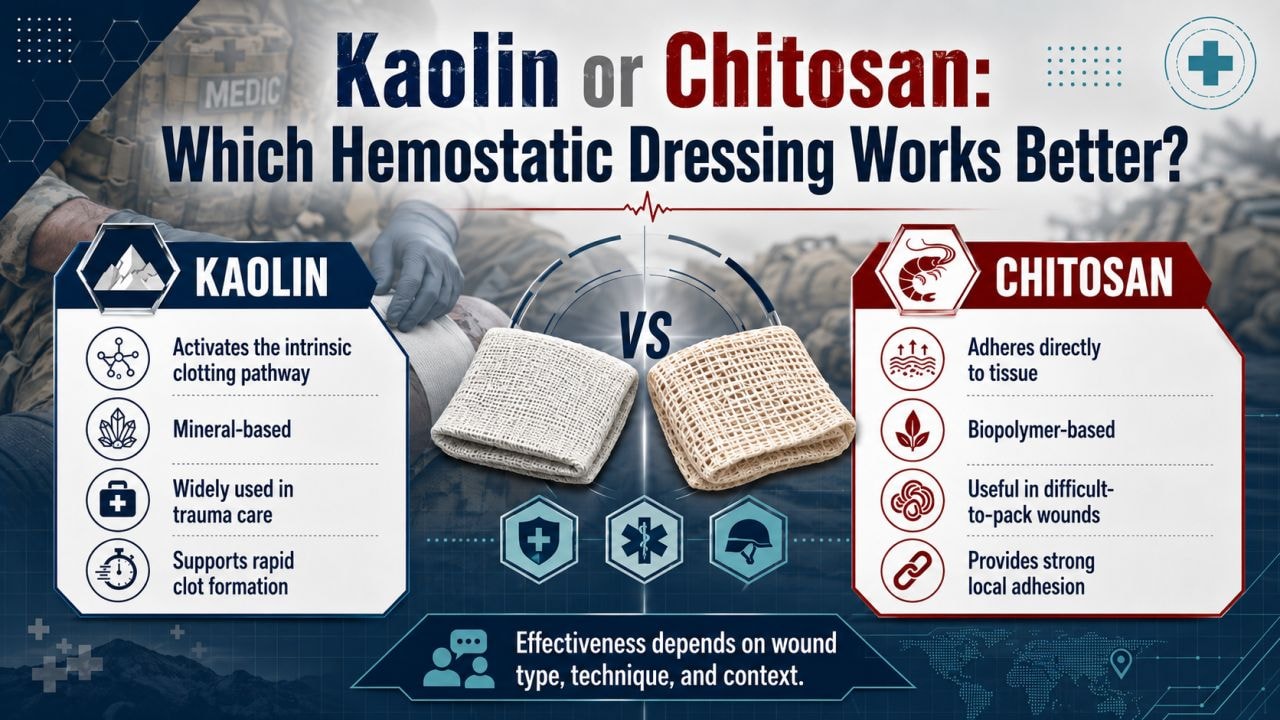
Kaolin vs. Chitosan: How They Work
The question of which hemostatic dressing is superior — kaolin-based (e.g., Combat Gauze) or chitosan-based (e.g., Celox Gauze, ChitoGauze) — is a recurring one in TCCC and CLS training. Both are designed for the same purpose: controlling severe compressible bleeding when a tourniquet cannot be applied or when wound packing is required. But they work through different mechanisms.
Kaolin-based dressings support clot formation by activating the intrinsic coagulation pathway.
Chitosan-based dressings create a mucoadhesive barrier by interacting with blood cells and tissues — working largely independently of the casualty's coagulation cascade.
On paper, this difference might suggest one technology should be faster or more reliable. In practice, the evidence does not identify a universal winner.
What the 2024 TCCC Guidelines Say
The 2024 TCCC Guidelines identify Combat Gauze as the hemostatic dressing of choice, with Celox Gauze and ChitoGauze listed as alternatives. They also recommend at least three minutes of direct pressure after applying any hemostatic dressing.
Some chitosan products advertise shorter application times — but faster biochemical action does not compensate for poor wound packing.
Technique Is the Variable That Matters
The research consistently shows that the single most important factor in hemostatic dressing effectiveness is not the agent — it is the technique:
- Pack to the source — gauze must reach the bleeding vessel, not just fill the wound entrance
- Pack completely — no air pockets; the wound must be fully packed
- Maintain firm direct pressure — for the full recommended time, without lifting to check
- Do not remove — once packed, leave it in place until the casualty reaches definitive care
A perfectly applied Combat Gauze outperforms a poorly applied Celox. A perfectly applied Celox outperforms a poorly applied Combat Gauze. The agent is secondary to the execution.
The Training Implication
Officers and first responders should train wound packing with the same dressing they carry operationally. Repetition builds the muscle memory required to pack a wound correctly under stress, in the dark, with one hand, on a moving casualty.
The debate over which hemostatic agent is superior is less important than ensuring every officer can pack a wound effectively with whatever they have on them.
Explore Topics
Written by
Paul Strauss MD
Content creator and writer sharing insights and stories.