"Don't Pack the Chest or Abdomen: Why Wound Packing Has Limits"
Wound packing is for compressible hemorrhage. Chest and abdomen wounds involve non-compressible internal bleeding — packing them can make things worse. The fix is the OR, not the field.
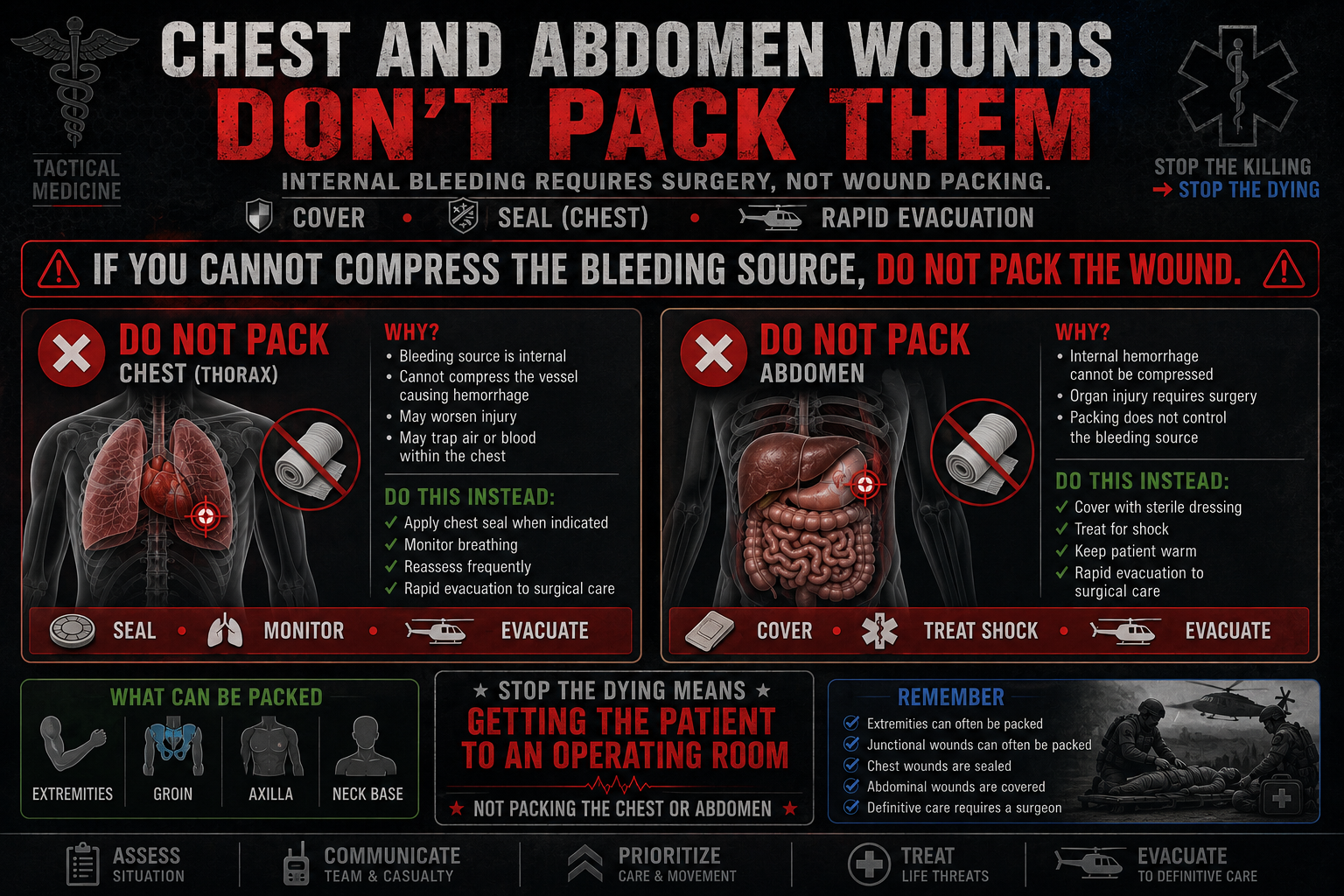
Wound packing is for compressible hemorrhage. Chest and abdomen wounds involve non-compressible internal bleeding — packing them can make things worse. The fix is the OR, not the field.
Why Wound Packing Works — and Where It Doesn't
Wound packing works when you can reach the bleeding vessel and compress it against a firm structure. In extremity and junctional wounds, there is a focal bleeding point that is compressible and survivable with packing.
In the chest and abdomen, bleeding is internal and deep: lungs, heart, major vessels (aorta, pulmonary vessels), liver, spleen, and mesenteric vessels. You cannot reach the source. There is no rigid structure to compress against effectively. Blood fills a cavity — not a confined space.
The Problem With Packing the Chest
Packing the chest can:
- Trap air and worsen a pneumothorax
- Increase pressure and contribute to tension physiology
- Interfere with lung expansion
The issue with applying a chest seal to all chest injuries as a result of gunshots is that you are creating the conditions for a tension hemopneumothorax. Once a chest seal is placed, the victim needs to be monitored for signs and symptoms of increased intrathoracic pressure. Law enforcement is typically task-overloaded in active shooter/mass casualty incidents — missing the early signs with time to intervene will result in mortality that should be preventable.
The Problem With Packing the Abdomen
Packing the abdomen externally does nothing for deep bleeding, can increase intra-abdominal pressure, and delays evacuation to definitive care.
The Fix Is NOT Field Packing — It's the OR
Definitive care for chest injuries requires a chest tube or thoracotomy. Abdominal injuries require a laparotomy. Both require blood products and surgical hemorrhage control.
This reinforces the core doctrine: Stop the Killing → Stop the Dying → Get to Definitive Care.
The Correct Field Protocols
For chest GSW:
- Apply a chest seal selectively with reassessment
- Monitor for respiratory distress and tension physiology
- Be ready to burp the seal or decompress
- Execute rapid evacuation
For abdominal GSW:
- Do NOT pack
- Cover with an occlusive or dry dressing
- Manage shock by keeping the patient warm
- Execute immediate transport
The Bottom Line
Wound packing is for compressible hemorrhage.
Chest and abdomen wounds involve non-compressible hemorrhage.
Stop the Dying means getting the patient to an operating room — not packing the chest or abdomen.
Know the difference. Train the difference. The casualty's survival depends on it.
Explore Topics
Written by
Paul Strauss MD
Content creator and writer sharing insights and stories.