Small Hole, Big Bleed: Deep Wound Packing for Penetrating Injuries
A small entry wound can hide massive internal hemorrhage. Understanding wound packing technique is the difference between a survivable and fatal injury.

One of the most dangerous misconceptions in trauma care is the assumption that wound severity correlates with wound size. A small entry wound — the kind that might look almost insignificant — can be the surface presentation of a devastating internal injury.
This is the "small hole, big bleed" problem. And it kills people who could have been saved.
Why Small Wounds Are Dangerous
A bullet traveling at high velocity creates a wound channel that is far larger than the entry wound suggests. The entry wound is the smallest part of the injury. The damage inside — to blood vessels, organs, and tissue — can be catastrophic.
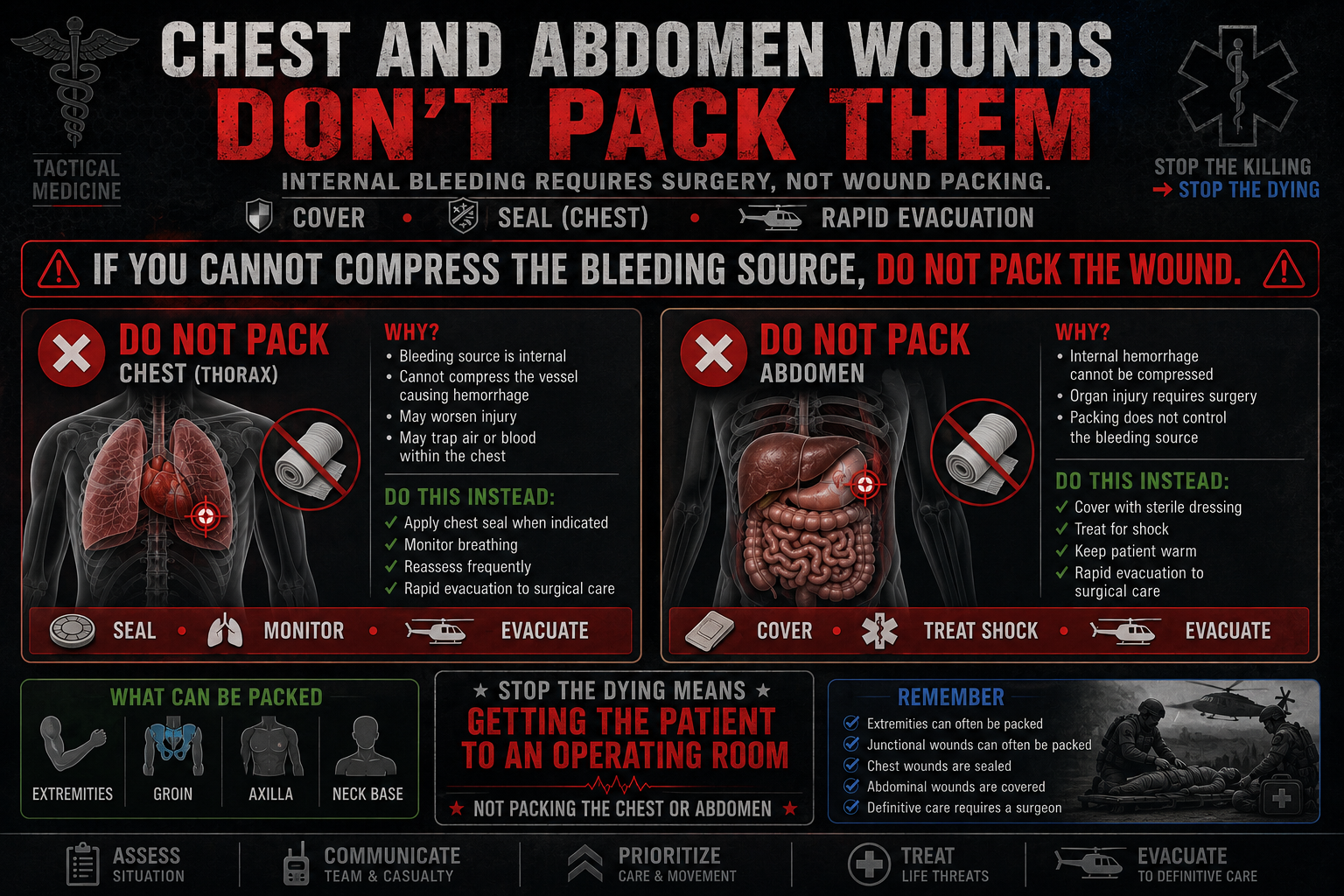
For wounds in areas where a tourniquet cannot be applied — the groin, axilla, neck base, and junctional areas — the only effective intervention is wound packing.
The Wound Packing Technique
Wound packing is not intuitive. The instinct is to cover the wound. The correct technique is to pack it — to fill the wound channel with hemostatic gauze, applying direct pressure to the bleeding source deep inside the wound.
The steps:
- Expose the wound — remove clothing and identify the wound
- Pack the wound — push hemostatic gauze into the wound channel, packing tightly from the deepest point outward
- Apply direct pressure — maintain firm, continuous pressure for a minimum of 3 minutes (longer for hemostatic gauze)
- Secure the packing — bandage over the packed wound to maintain pressure
The most common error is insufficient depth. Packing gauze on top of a wound rather than into it does not control the bleeding source. The gauze must reach the bleeding vessel.
Hemostatic Agents
Hemostatic gauze — gauze impregnated with a clotting agent — is the standard for wound packing in tactical medicine. The two most common agents are:
Kaolin (QuikClot) — activates the clotting cascade through contact with the clotting factors in blood
Chitosan (HemCon/Combat Gauze) — creates a physical barrier and promotes clotting through electrostatic interaction
Research has consistently shown that technique matters more than agent selection. A properly packed wound with plain gauze will outperform a poorly packed wound with the best hemostatic agent available.
Training Implications
Wound packing is a perishable skill. It must be practiced on realistic wound simulators, under stress, with the actual equipment that will be used in the field.
Officers and first responders who have only seen wound packing demonstrated — but have never done it themselves — will struggle to execute it correctly under the stress of a real incident.
The small hole, big bleed problem is solvable. The solution is training.
Explore Topics
Written by
Paul Strauss MD
Content creator and writer sharing insights and stories.