The History of the Tourniquet
The tourniquet's reputation has swung dramatically over 400 years — from lifesaving device, to something medicine discouraged, and back again. Understanding that history explains why modern doctrine changed, and why it matters.
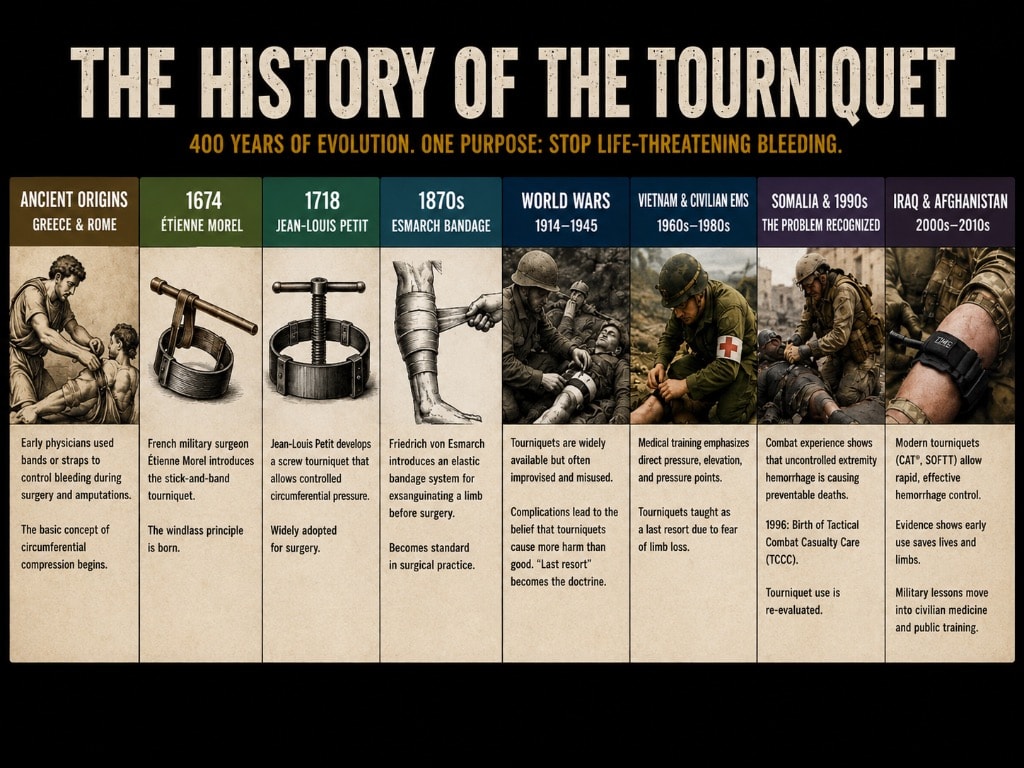
The history of the tourniquet is surprisingly long, but its reputation has swung dramatically — from a lifesaving device, to something medicine discouraged, and then back to one of the most important tools in modern trauma care.
Ancient Origins
The basic idea — circumferential compression of a limb to stop bleeding — goes back to antiquity. Greek and Roman physicians described using bands or straps around extremities to control hemorrhage, particularly during surgery and amputation. These early devices were essentially constricting bands rather than modern mechanical tourniquets.
The word tourniquet comes from the French tourner, meaning "to turn."
1600s: The Mechanical Tourniquet Emerges
A major development occurred in the 17th century, when French military surgeon Étienne Morel is generally credited with introducing a stick-and-band device around 1674. A stick was twisted to tighten a band around the limb — the basic mechanical principle behind today's windlass tourniquet.
This was particularly important for battlefield amputations, which were performed without modern vascular clamps or electrocautery.
1700s: Jean-Louis Petit
In 1718, French surgeon Jean-Louis Petit developed a screw-type tourniquet. His device could produce controlled circumferential pressure and was widely adopted for surgery. Tourniquets increasingly became associated with creating a relatively bloodless surgical field rather than simply emergency hemorrhage control.
1800s: Esmarch and Surgical Tourniquets
In the 19th century, German surgeon Friedrich von Esmarch introduced an elastic bandage system for exsanguinating a limb before surgery and then maintaining arterial occlusion. The Esmarch bandage, introduced in the 1870s, became extremely influential in surgical practice. Later pneumatic tourniquets allowed pressure to be controlled much more precisely, leading toward the systems still used in orthopedic surgery.
World War I and World War II: Lifesaving — But Dangerous
Tourniquets were widely available to military forces during the World Wars, but their use produced mixed results.
A major problem wasn't necessarily the concept — it was how tourniquets were being used. Improvised narrow straps could damage tissue. Tourniquets might be placed unnecessarily, inadequately tightened, concealed beneath clothing, or left on for very long periods when evacuation was delayed.
Consequently, military and civilian medicine increasingly came to associate tourniquets with ischemia, nerve injury, gangrene, and limb loss.
This helped create a doctrine that would persist for decades: a tourniquet is a last resort.
Vietnam Era and Civilian EMS: Tourniquets Fall Out of Favor
By the latter half of the 20th century, conventional first-aid teaching generally emphasized a progression: direct pressure → elevation → pressure points → tourniquet only as a last resort.
Many EMTs, paramedics, nurses, and physicians trained during this period were specifically warned that applying a tourniquet might result in the patient losing the limb. That belief became deeply embedded in civilian trauma education.
Somalia and the 1990s: The Problem Becomes Apparent
Combat experience during the 1990s increasingly demonstrated that extremity hemorrhage was causing potentially preventable battlefield deaths.
The 1993 Battle of Mogadishu became particularly influential in the development of modern tactical casualty-care thinking.
In 1996, Butler, Hagmann, and Bellamy published the landmark paper "Tactical Combat Casualty Care in Special Operations." It challenged several assumptions inherited from conventional civilian trauma care and helped establish what became Tactical Combat Casualty Care (TCCC).
One of the critical changes was recognizing that, under fire, attempting complicated hemorrhage-control techniques could be inappropriate.
For life-threatening extremity hemorrhage: put on a tourniquet, put it on quickly, get the casualty and rescuer out of danger.
Iraq and Afghanistan Change the Evidence
The wars in Iraq and Afghanistan produced enormous experience with modern commercial tourniquets.
Devices such as the Combat Application Tourniquet (CAT) and SOF Tactical Tourniquet allowed rapid, reproducible arterial occlusion. Research from military trauma systems demonstrated an extremely important distinction:
Tourniquets applied early — before profound hemorrhagic shock — were associated with substantially better outcomes than waiting until the casualty had deteriorated.
At the same time, the feared assumption that tourniquet use automatically meant limb loss was not supported by the modern battlefield experience. That essentially turned decades of conventional teaching upside down.
2000s–2010s: Military Lessons Move Into Civilian Medicine
The lessons from TCCC increasingly entered civilian trauma systems through programs such as Tactical Emergency Casualty Care (TECC) and later the Stop the Bleed campaign.
The 2012 Sandy Hook shooting and the subsequent Hartford Consensus were especially important in accelerating civilian adoption of immediate hemorrhage control.
Tourniquets moved from something primarily carried by military medics to equipment increasingly found with law enforcement, Fire/EMS, hospitals, schools, and public-access bleeding-control kits.
The Doctrine Changed
The evolution is particularly relevant to tactical medicine because it represents a larger change in how we think about preventable death.
The historical approach was essentially: "Try everything else before using a tourniquet."
Modern trauma doctrine is closer to: "For life-threatening extremity hemorrhage, use an effective tourniquet early."
And in an active-threat environment, the threshold can be even more operationally driven. A properly placed tourniquet is a rapid intervention measured in seconds, making it one of the few meaningful medical interventions that can reasonably occur during the Stop the Killing phase.
Once the environment permits the transition to Stop the Dying, the casualty can receive a more complete MARCH assessment, hemorrhage reassessment, wound packing or junctional hemorrhage control where appropriate, and rapid evacuation toward definitive surgical care.
The 400-Year Circle
The history of the tourniquet is almost a complete circle:
Battlefield necessity → accepted hemorrhage control → fear of complications → "last resort" → battlefield evidence → early lifesaving intervention.
That evolution is a particularly useful lens for understanding modern tactical medicine — because it demonstrates how medical doctrine can persist long after the operational evidence supporting it has changed.
Explore Topics
Written by
Paul Strauss MD
Content creator and writer sharing insights and stories.