Minutes Matter: Why Rapid Trauma Care Saves Lives
Every minute of delay in treating life-threatening hemorrhage increases mortality. Understanding the timeline is the first step toward changing outcomes.

The phrase "golden hour" has shaped trauma medicine for decades. The idea is simple: get a critically injured patient to definitive surgical care within 60 minutes and survival rates improve dramatically.
But in the context of active shooter and mass casualty incidents, 60 minutes is not the relevant timeframe. Minutes — sometimes seconds — are.
The Real Timeline
Modern trauma research has refined our understanding of hemorrhagic death. The data is unambiguous:
- Mortality from uncontrolled extremity hemorrhage increases 2–4% for every minute of delay
- Tension pneumothorax can be fatal within minutes of onset
- The majority of preventable deaths in active shooter incidents occur from hemorrhage that was controllable with basic interventions
The "golden hour" was never designed for the active shooter environment. It was developed for motor vehicle accidents and other trauma scenarios where EMS response times are measured in minutes, not the seconds that separate life from death in a mass shooting.
What "Minutes Matter" Means in Practice
In an active shooter incident, the person most likely to provide the first life-saving intervention is not a paramedic. It is a law enforcement officer, a teacher, a bystander, or the victim themselves.
This is not a failure of the EMS system. It is a mathematical reality. EMS cannot be everywhere. The average active shooter incident is over in under 5 minutes. EMS response times average 7–10 minutes in urban environments.
The gap between when the shooting stops and when EMS arrives is where preventable deaths occur. Closing that gap requires:
- Trained first responders — law enforcement officers who can apply tourniquets, pack wounds, and recognize tension pneumothorax
- Equipped bystanders — civilians who have been trained in Stop the Bleed and carry or have access to bleeding control supplies
- Pre-positioned resources — bleeding control kits in schools, offices, and public spaces
The Interventions That Save Lives
The interventions that prevent hemorrhagic death are not complex. They are:
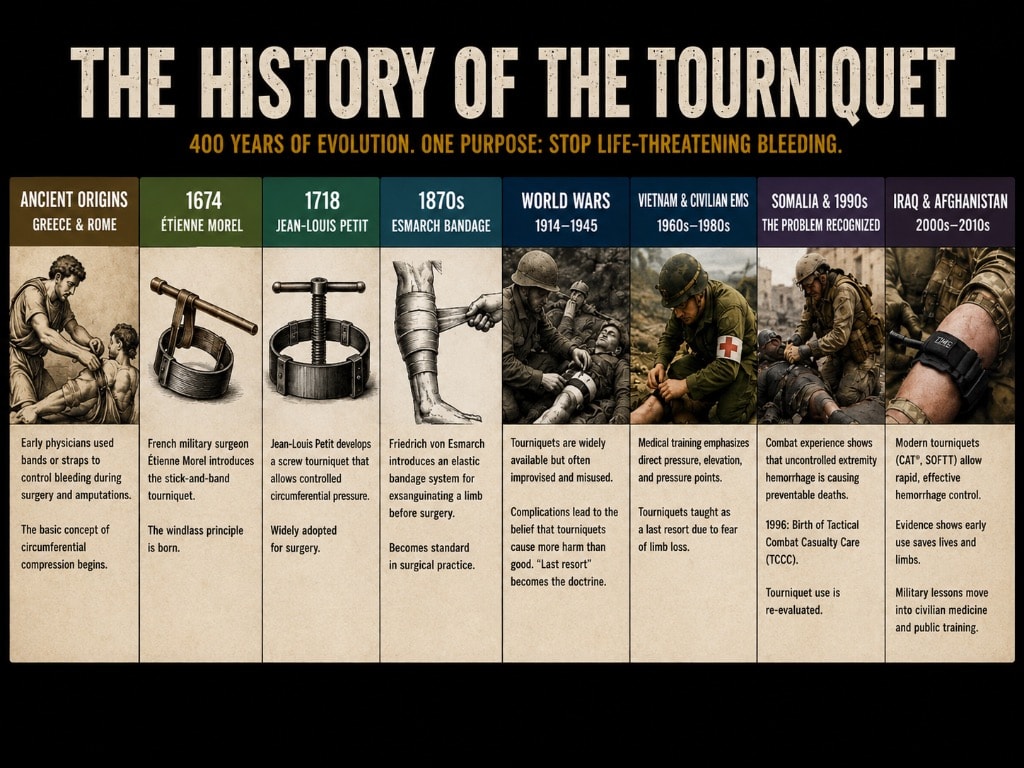
Tourniquet application — for extremity hemorrhage, a properly applied tourniquet stops bleeding immediately. It is the single most effective intervention for survivable gunshot wounds to the arms and legs.
Wound packing — for wounds in areas where a tourniquet cannot be applied (groin, axilla, neck base), wound packing with hemostatic gauze is the standard of care.
Chest seal application — for penetrating chest wounds, a chest seal prevents the development of tension pneumothorax, which is rapidly fatal if untreated.
These interventions can be taught to non-medical personnel in hours. They require no advanced training, no complex equipment, and no medical license.
The Training Imperative
Minutes matter. That is not a slogan — it is a clinical reality supported by decades of military and civilian trauma data.
The question is not whether to train. The question is how many preventable deaths will occur before training becomes universal.
TacMed USA exists to answer that question with action.
Explore Topics
Written by
Paul Strauss MD
Content creator and writer sharing insights and stories.