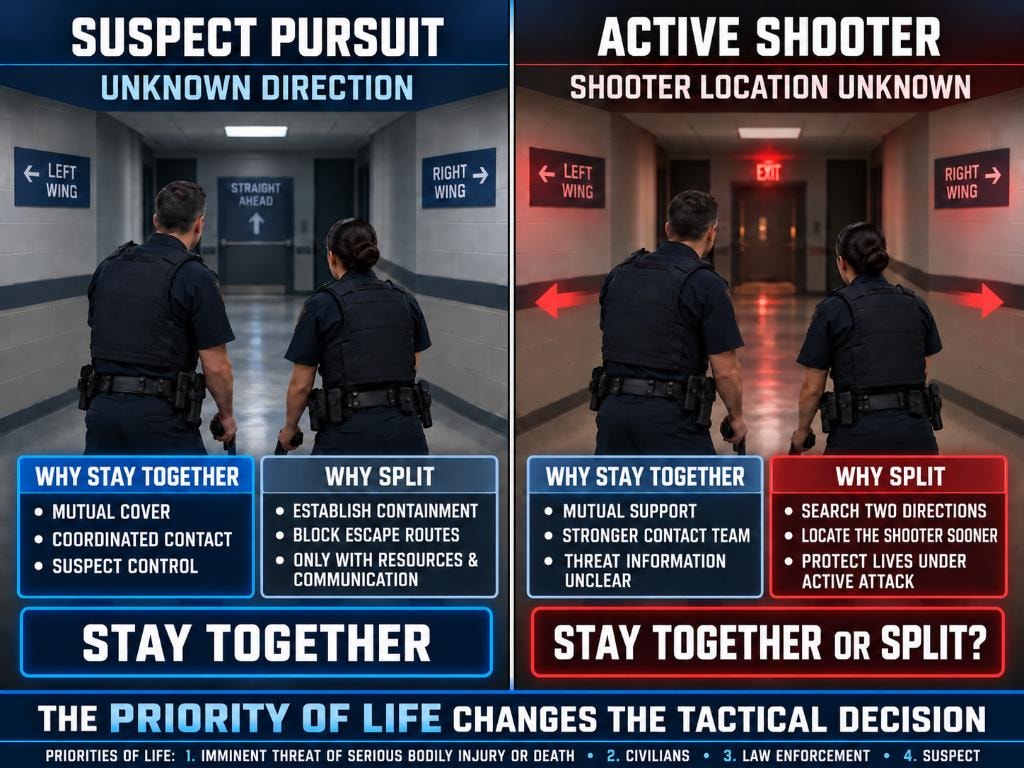
Do We Still Step Over All the Victims?
"Step over the victims and move toward the sound of gunfire" remains appropriate when officers are responding to a confirmed, ongoing threat. But what happens after the initial attacker has been neutralized?
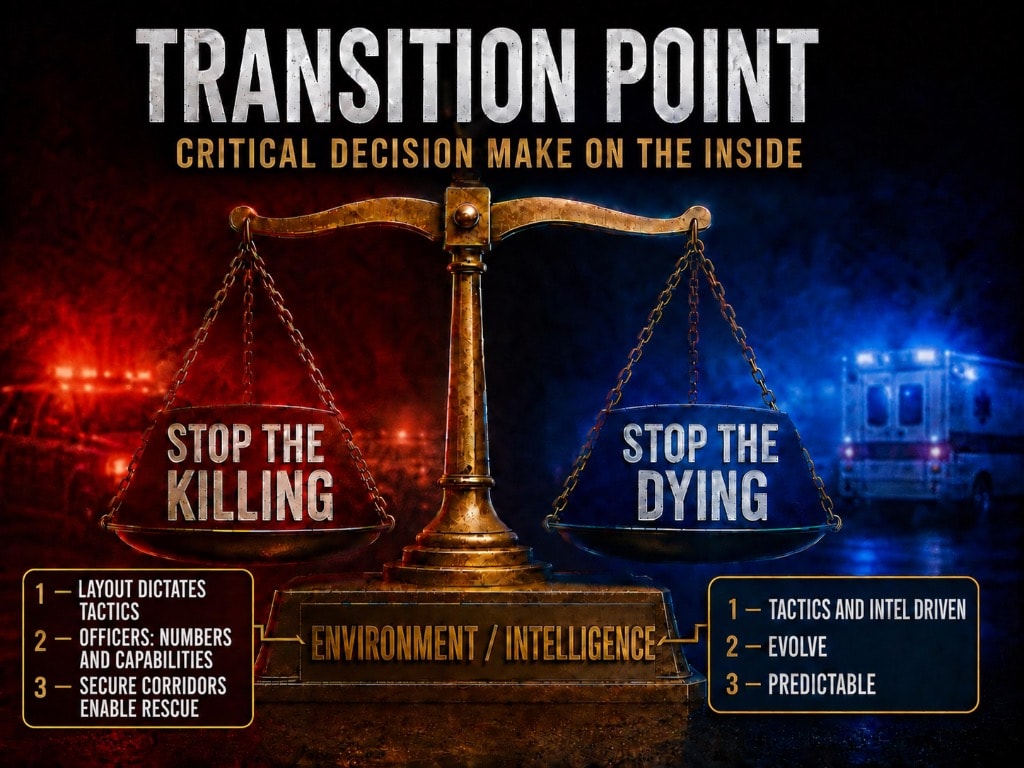
"Step over the victims and move toward the sound of gunfire" remains appropriate when officers are responding to a confirmed, ongoing threat. But what happens after the initial attacker has been neutralized?
Do we continue stepping over every victim while every available officer searches for a possible additional threat?
The answer should depend on resources, intelligence and conditions inside the crisis site, not the automatic continuation of the initial response doctrine.
The decision is complex and uncertain
The interior commander may not immediately know whether the incident is:
- A more likely active-shooter incident involving a single suspect;
- An incident involving an unidentified second suspect;
- Or the less likely but high-consequence possibility of a complex coordinated terrorist attack involving multiple attackers, multiple crisis sites within the same location or simultaneous attacks at separate locations.
The possibility of an additional or coordinated threat cannot be ignored. However, every incident should not automatically be treated as though a complex coordinated attack is underway. Doing so could commit every available officer to searching for a theoretical threat while known victims with preventable injuries receive no care.
Resources do not arrive all at once
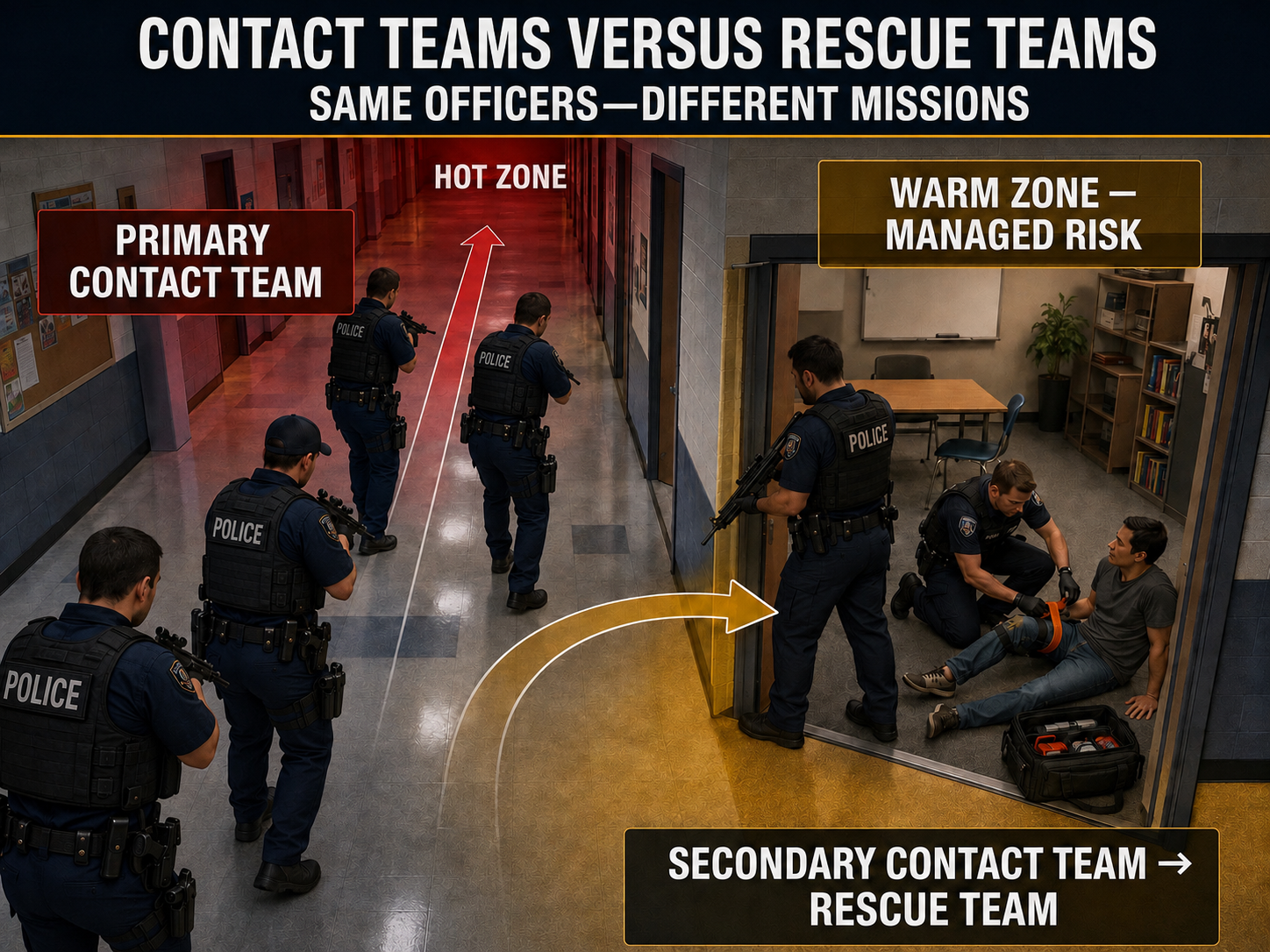
Law-enforcement and Fire/EMS resources arrive in stages. The first officers may have only enough personnel to form a contact team and move toward the active stimulus. As additional officers arrive, the interior commander gains the ability to assign separate missions:
- Continue searching for additional threats;
- Secure hallways, stairwells and evacuation corridors;
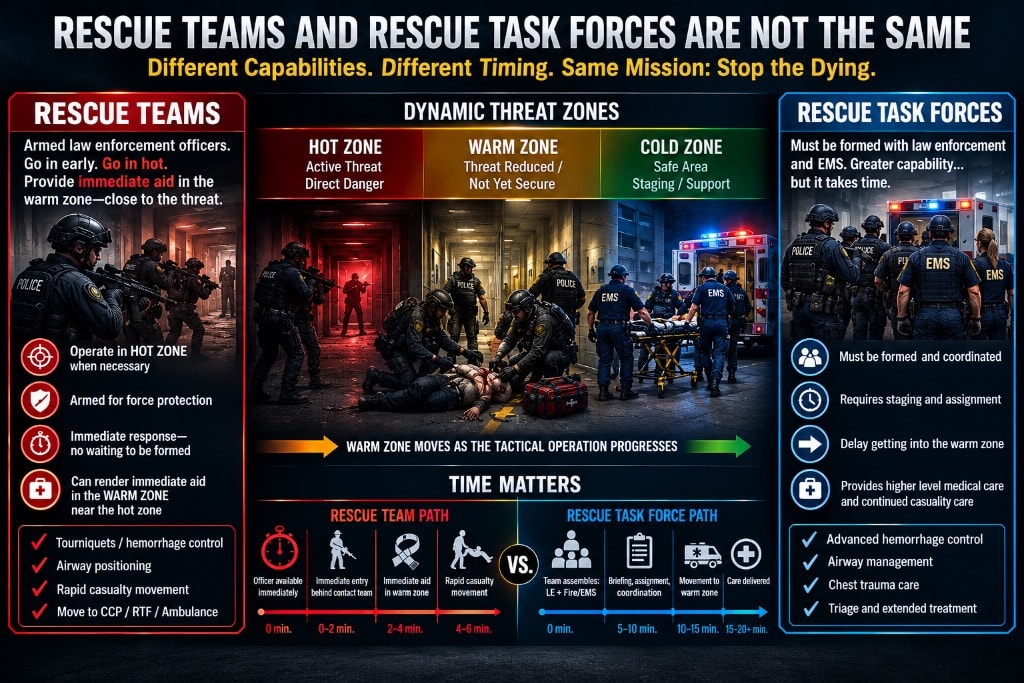
- Form law-enforcement rescue teams;
- Locate, treat and move victims;
- Provide force protection for entering Fire/EMS rescue task forces.
The balance between Stop the Killing and Stop the Dying should therefore change as resources increase. A decision that was appropriate during the first three minutes may no longer be appropriate five minutes later when additional officers and medical resources are available.
The interior layout adds uncertainty
The physical layout of the crisis site further complicates the decision. Responding officers may not know:
- How many rooms, hallways or floors must be searched;
- Whether separate areas are connected;
- Where victims are located;
- Whether gunfire heard in different areas represents multiple attackers, echoes or delayed reports;
- Which hallways or stairwells can serve as secure evacuation corridors;
- Whether areas immediately behind the contact team can be treated as manageable-risk warm zones.
In a large school, hospital, hotel, office building or entertainment venue, waiting until every room, hallway and floor has been completely searched could create a substantial delay before anyone begins treating known victims.
Warm zones are not locations where risk has been eliminated. They are areas where risk is being actively managed. When sufficient officers are available, a primary contact team can continue the threat search while a secondary team transitions into a rescue mission only a short distance behind it.
When does "step over the victims" stop being appropriate?
The doctrine was developed to prevent officers from stopping to provide prolonged care while an attacker was still actively killing people. It was never intended to require officers to ignore every victim indefinitely after the known threat had been neutralized.
Without credible evidence of another active threat, continuing to step over critically injured victims may transform a lifesaving doctrine into a cause of preventable death. A victim who could survive with a tourniquet, airway positioning or rapid evacuation may die while every officer searches every room for a theoretical second attacker.
Conversely, committing every officer to casualty care could leave responders and victims vulnerable if credible intelligence indicates another threat. The answer is not an automatic choice in either direction.
The interior commander must continually rebalance the mission
The interior commander must evaluate:
- Is there an active stimulus?
- Is there credible intelligence indicating another attacker or crisis site?
- What areas have been cleared, bypassed or remain unknown?
- How many law-enforcement resources are available?
- Where are the known victims, and what is their condition?
- Have Fire/EMS resources arrived and formed rescue task forces?
- Can some officers continue Stop the Killing while others begin Stop the Dying?
This is not a one-time decision. It must be continuously reassessed as intelligence develops, suspect status changes, additional victims are located and more law-enforcement and Fire/EMS resources arrive.
The appropriate direction is:
Continue Stop the Killing where credible threat information requires it. Begin Stop the Dying wherever available resources and manageable risk permit it.
So, do we still step over all the victims?
Yes—while moving toward a confirmed active threat.
No—not automatically after the initial threat has been neutralized.
Once the threat status, intelligence or available resources change, the command decision must change with them. The mission is not complete when the shooting stops, and the doctrine should not require officers to continue stepping over potentially survivable victims when personnel are available to begin saving them.
Explore Topics
Written by
Paul Strauss MD
Content creator and writer sharing insights and stories.