Rescue Teams and Rescue Task Forces Are Not the Same
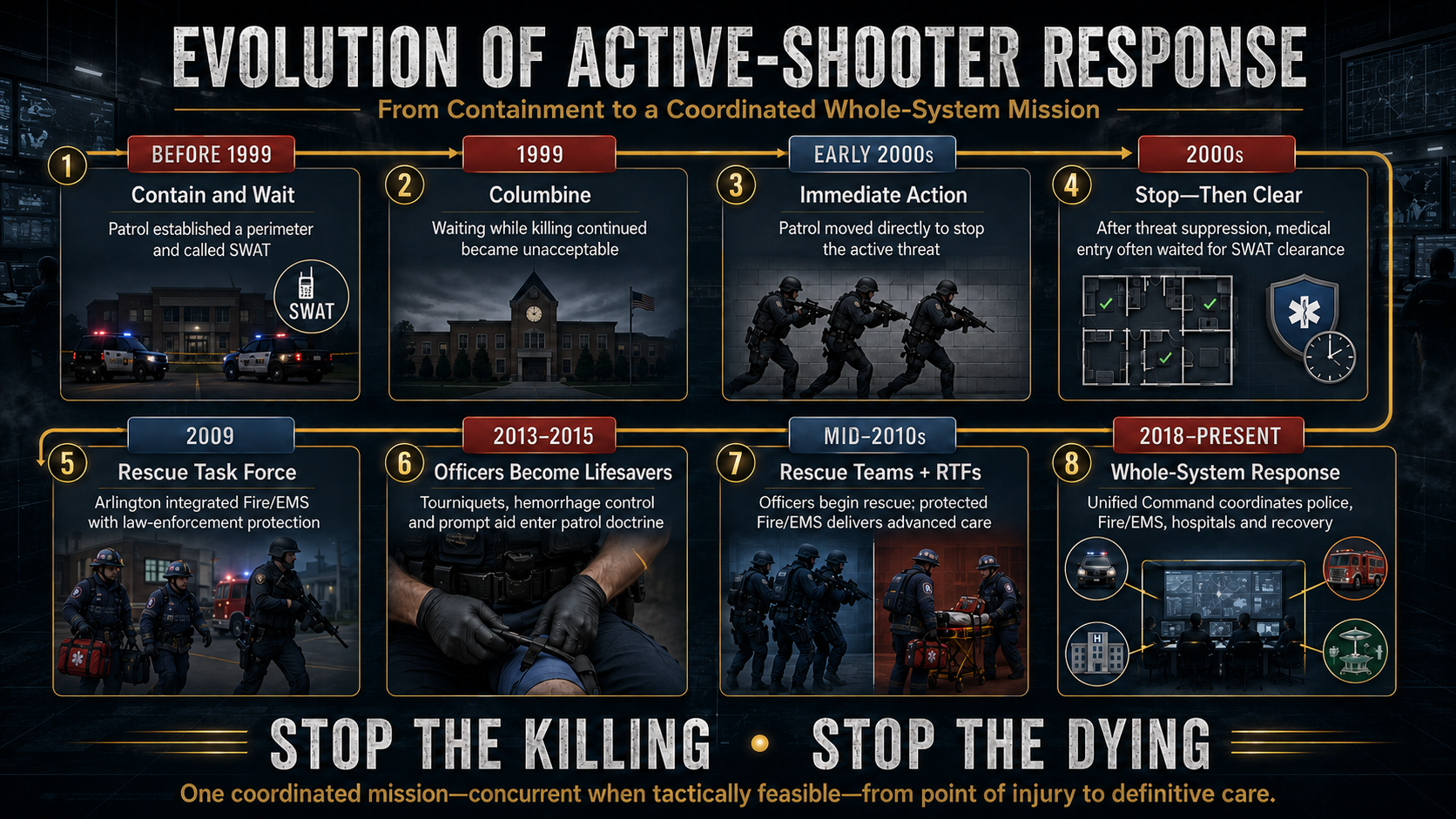
In an active shooter/mass-casualty incident, the terms Rescue Team and Rescue Task Force (RTF) are sometimes used as though they describe the same capability. They do not.
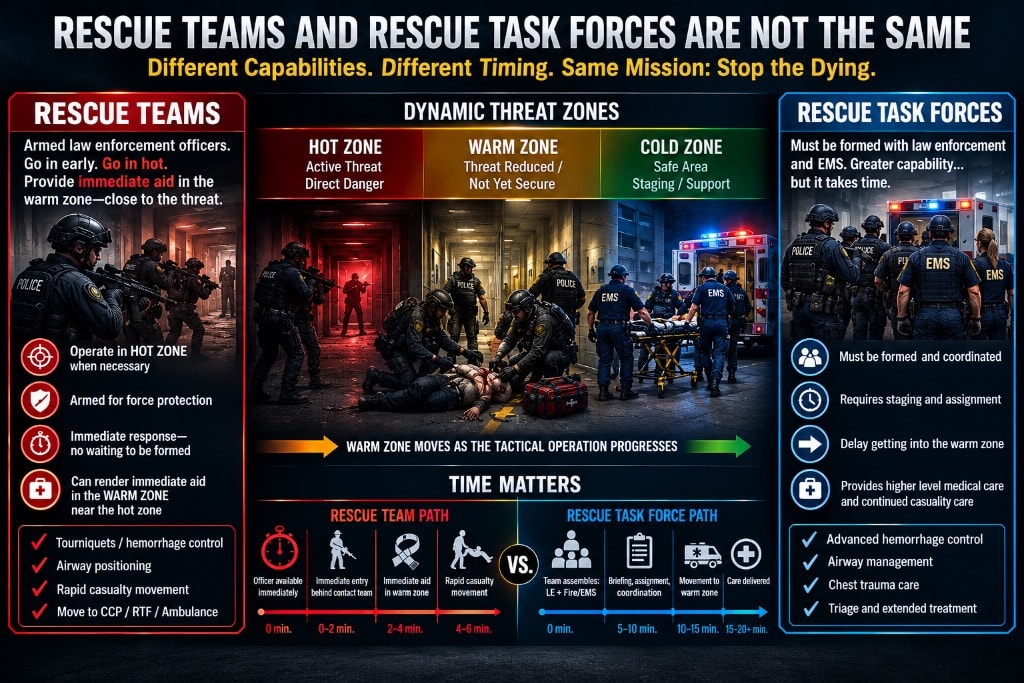
In an active shooter/mass-casualty incident, the terms Rescue Team and Rescue Task Force (RTF) are sometimes used as though they describe the same capability. They do not. Both contribute to Stop the Dying, but they enter the response at different times, accept different levels of risk, and provide different levels of medical care.
Rescue Teams: Speed and Access
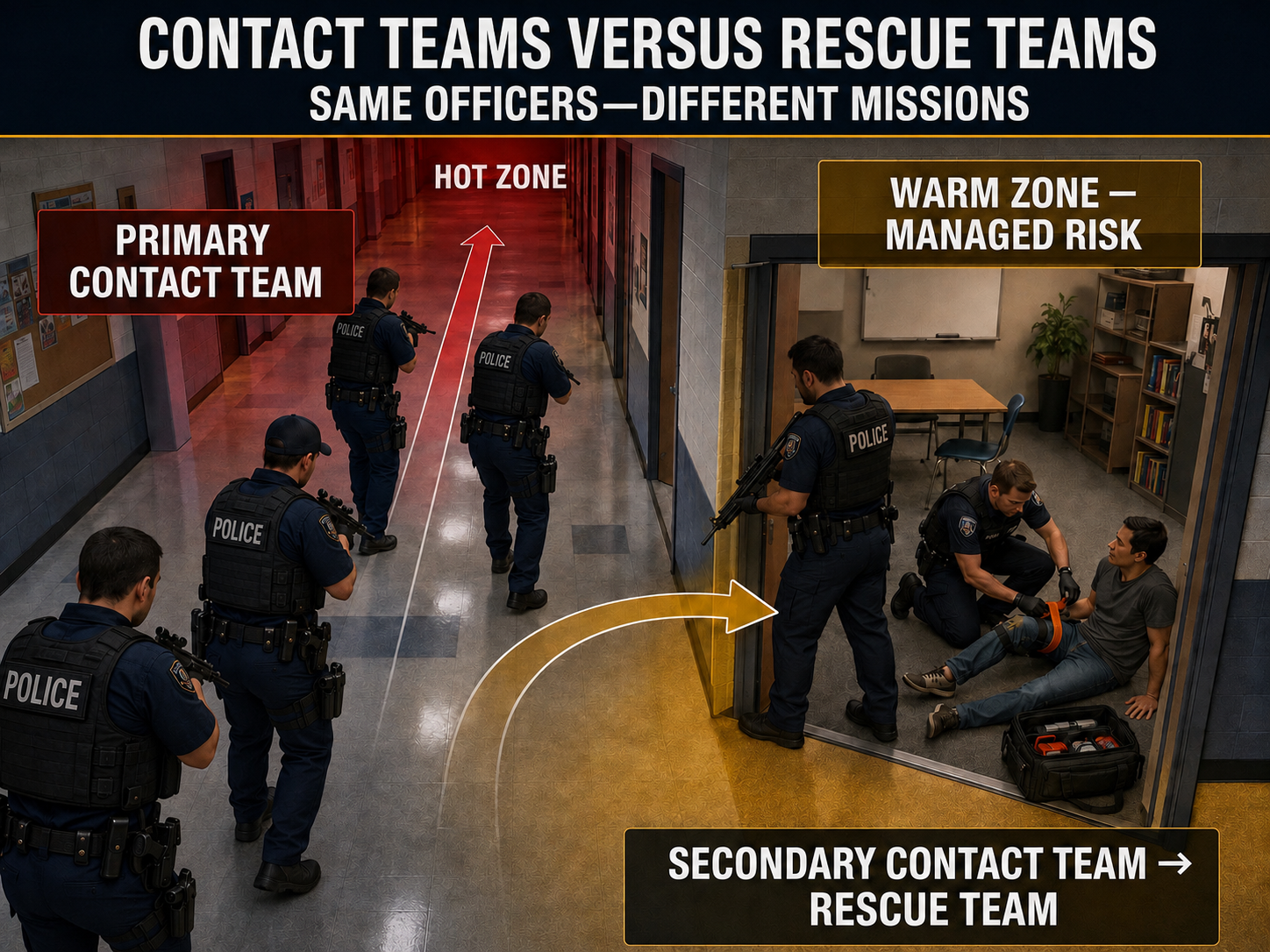
A law-enforcement Rescue Team consists of armed officers who already possess their own force protection. Because they are law enforcement officers, they can operate in the hot zone when the tactical situation requires it and can move immediately into areas that have transitioned to a warm zone—even when that warm zone is only feet behind the contact team or the evolving hot-zone boundary.
This creates an important operational advantage: time.
Once an area has been sufficiently cleared or the threat has moved, been contained, or been neutralized, available officers can transition from a tactical mission to a rescue mission. They do not necessarily need to wait for Fire/EMS personnel to assemble with law enforcement before beginning lifesaving interventions.
Their medical capabilities may be limited, but the interventions they can perform can have enormous impact:
- Control severe extremity hemorrhage with tourniquets; position casualties to protect the airway when appropriate; move casualties rapidly out of danger; and begin evacuation toward a CCP, RTF, ambulance, or other higher level of care.
For a casualty with rapidly fatal but preventable hemorrhage, basic care delivered now may be more valuable than advanced care delivered later.
Rescue Task Forces: Greater Capability, but Potentially Later Access
An RTF is fundamentally different. It typically combines Fire/EMS medical personnel with law-enforcement protection to bring a substantially greater medical capability into the warm zone.
That capability matters. Fire/EMS personnel may provide more comprehensive assessment, wound packing and pressure dressings, junctional hemorrhage management, chest-trauma interventions, airway management, triage, and other TECC-appropriate treatment.
But an RTF has an operational limitation that must be acknowledged: it has to be formed, coordinated, and deployed.
Fire/EMS must arrive and stage. Law-enforcement protection must be available. The tactical environment must be communicated. Teams must be organized and receive an assignment through the incident command structure. Depending on the incident, those steps can create a meaningful delay between the moment casualties become accessible and the moment an RTF reaches them.
That delay becomes clinically important when minutes matter.
The Tradeoff: Capability vs. Time
The question therefore should not be:
"Rescue Team or Rescue Task Force?"
It should be:
"What is the fastest appropriate level of care we can safely bring to the casualty right now, while simultaneously moving that casualty toward higher-level care?"
A Rescue Team may reach a critically bleeding victim quickly but possess relatively limited medical capabilities. An RTF may deliver considerably more sophisticated care but reach that same victim later.
That creates a fundamental tactical-medical balance:
TIME TO CARE × CAPABILITY OF CARE
The objective is not to wait for the best medical resource when an immediately available resource can prevent death.
A Layered Stop-the-Dying Response
These concepts work best as complementary capabilities rather than competing models:
Contact Team → Rescue Team → RTF → Transport → Definitive Care
As the contact team pushes the threat forward, law-enforcement Rescue Teams can operate immediately behind that tactical effort, entering newly created warm areas and performing rapid lifesaving interventions and casualty movement. RTFs can then follow into appropriately secured warm zones, providing a higher level of medical care, triage, and continued evacuation.
The warm zone should therefore not be viewed as a single static geographic location. It can evolve immediately behind the tactical operation as risk is continually assessed and managed.
The key principle is simple:
Do not delay an intervention capable of preventing death merely because a higher level of care has not yet reached the casualty.
The law-enforcement Rescue Team can provide speed, access, force protection, immediate hemorrhage control, and evacuation. The Rescue Task Force provides greater medical capability and sustained casualty care.
We need both.
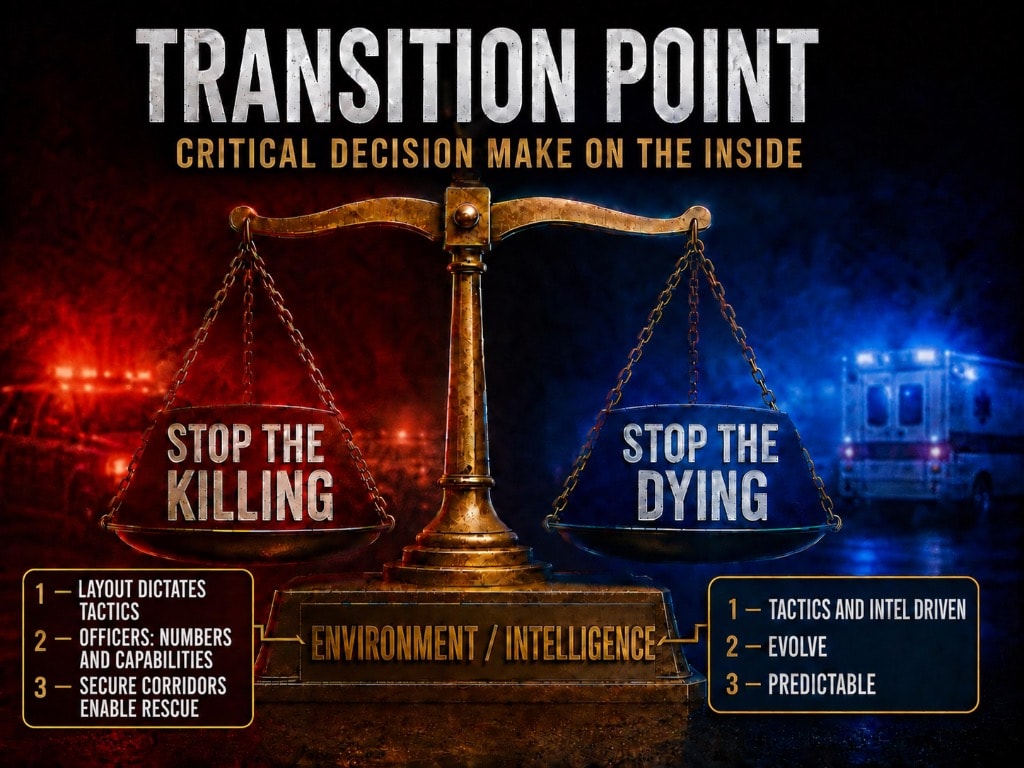
Stop the Killing creates the opportunity to save lives. Stop the Dying requires getting appropriate care to victims as quickly as the tactical environment permits.
Explore Topics
Written by
Paul Strauss MD
Content creator and writer sharing insights and stories.