The Evolution of Active-Shooter Response: From Containment to a Whole-System Mission
Before Columbine, law-enforcement agencies commonly approached an armed attack using tactics developed for barricaded suspects and hostage situations.
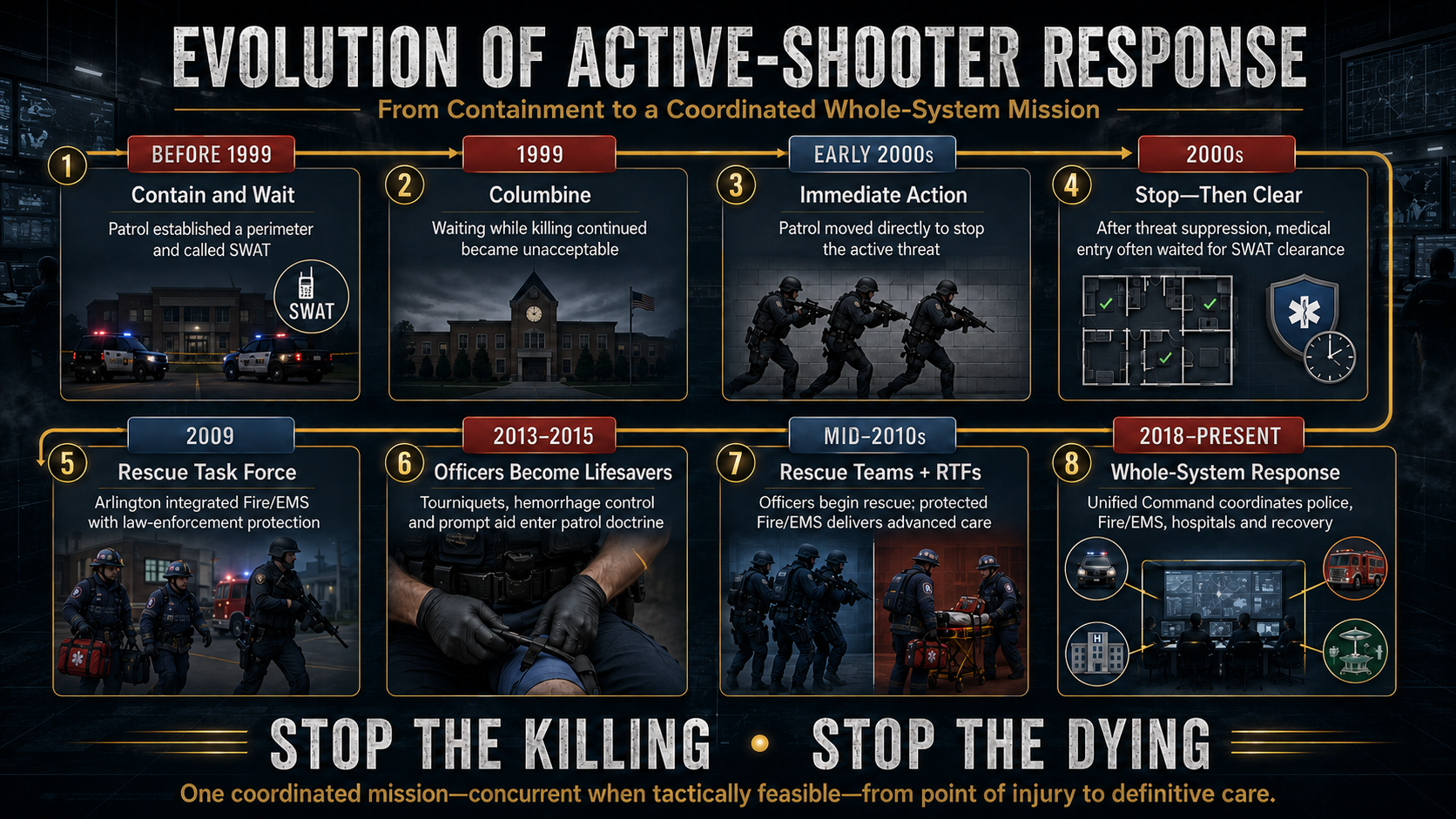
Before Columbine, law-enforcement agencies commonly approached an armed attack using tactics developed for barricaded suspects and hostage situations. Patrol officers established a perimeter, contained the location, called out the suspect, and waited for SWAT.
That approach assumed time was available for specialized teams to assemble, plan, and act. In an active-shooter incident, however, time is measured in additional victims.
1999: Columbine changes the mission
The Columbine High School attack became a defining moment in American law-enforcement doctrine. Officers established containment while victims remained inside and the killing continued. The event exposed a fundamental problem: an active shooter is not simply a barricaded suspect. The suspect is actively creating victims, and waiting may allow the casualty count to increase.
The emerging lesson was unmistakable: patrol could no longer remain outside waiting for SWAT while people were being killed.
Early 2000s: Patrol takes immediate action
Departments began training patrol officers in Immediate Action Rapid Deployment. The first arriving officers were expected to move toward the active threat and neutralize it without waiting for a fully assembled SWAT team.
This represented a major doctrinal change. Patrol became the initial tactical response—not merely the force that established a perimeter for arriving specialists.
However, the mission remained heavily focused on stopping the attacker. After the threat was neutralized, officers often continued clearing the entire crisis site while Fire/EMS waited outside for the building to be declared secure. Law enforcement had learned to enter sooner, but emergency medical care could still be significantly delayed.
The doctrine had improved at stopping the killing, but it had not yet fully addressed stopping the dying.
2009: The Rescue Task Force model
The Rescue Task Force concept documented by Arlington County introduced another important change. Fire/EMS providers, protected by law-enforcement officers, could enter areas that had been cleared but were not yet completely secure.
Instead of waiting for an entire school, business, or other large structure to be declared safe, protected medical teams could enter the warm zone to provide hemorrhage control, triage, treatment, and casualty movement.
The RTF model recognized that the warm zone is not necessarily a place of zero risk. It is a location where the remaining risk has been evaluated and managed sufficiently to permit a coordinated lifesaving operation.
2013–2015: Officers become lifesavers
Military experience and the Hartford Consensus reinforced that law-enforcement officers must serve as the bridge between threat suppression and the integrated medical response.
Officers were increasingly trained and equipped to recognize life-threatening bleeding, apply tourniquets, position casualties, and begin rapid extraction. Agencies also strengthened policies directing officers to promptly provide or obtain medical assistance for injured community members when tactically feasible.
This did not transform officers into paramedics. It recognized that the officer already inside may be the only person capable of preventing a casualty from bleeding to death before Fire/EMS can enter.
Every officer carrying a tourniquet—and knowing how and when to use it—became an essential part of the response.
Mid-2010s: Rescue teams and RTFs
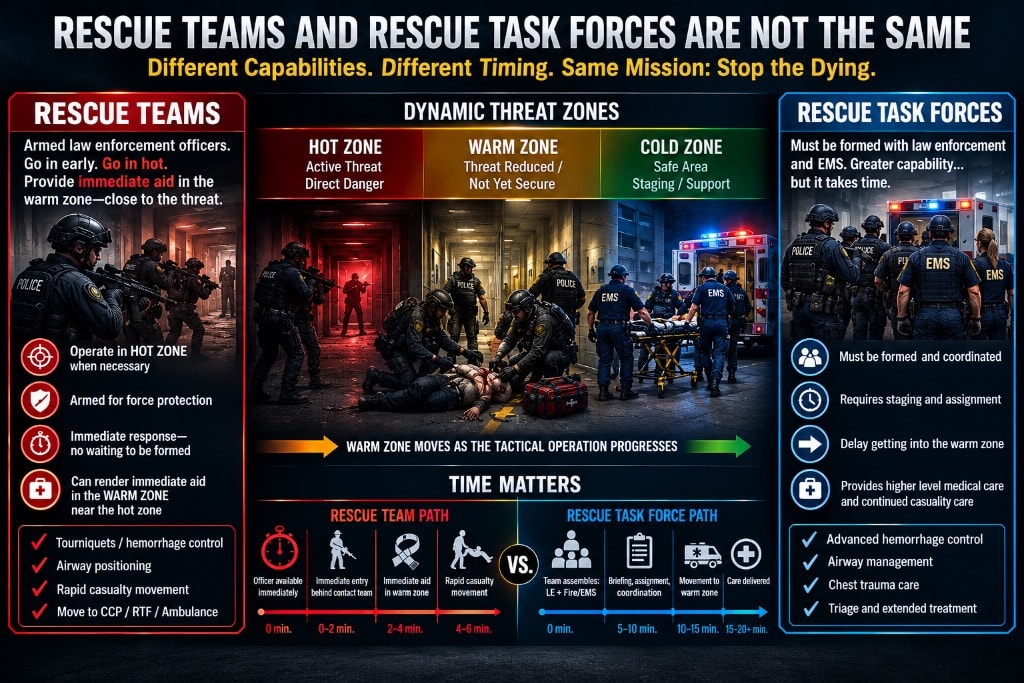
The next evolution was recognizing that law-enforcement rescue teams and Rescue Task Forces are related but distinct capabilities.
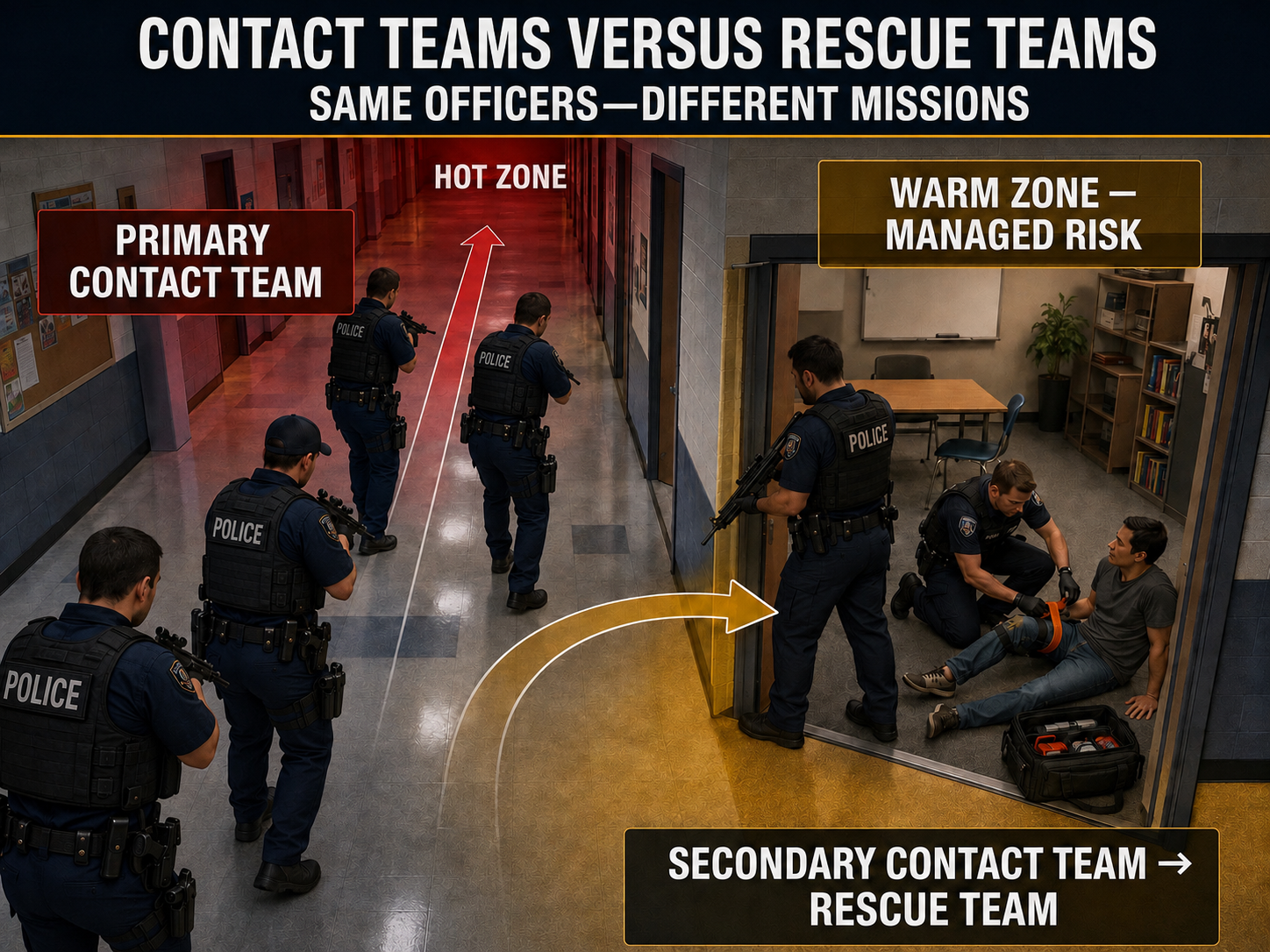
A law-enforcement rescue team consists of armed officers capable of operating closer to the unresolved threat. Its members can locate casualties, provide immediate lifesaving interventions, and move victims away from danger. These officers may have only basic medical capabilities, but they can reach victims sooner.
A Rescue Task Force combines Fire/EMS medical providers with law-enforcement force protection. It brings more advanced assessment, treatment, triage, and evacuation capabilities—but requires time to assemble, organize, and deploy.
The most effective response does not treat these as competing models. Officer rescue teams begin the rescue mission immediately, while protected Fire/EMS RTFs follow with a higher level of care.
2018 to the present: A coordinated whole-system response
The publication of NFPA 3000 in 2018 reflected the growing understanding that an active-shooter or hostile event cannot be managed by one discipline. Effective response requires a coordinated program involving law enforcement, Fire/EMS, emergency management, communications, facilities, hospitals, trauma systems, public health, and recovery resources.
Unified Command must coordinate these capabilities as one mission—not as separate agencies operating near one another.
The transition from Stop the Killing to Stop the Dying is therefore not a radio announcement made only after the entire crisis site has been cleared. It is a command decision that reallocates resources based on suspect status, known victims, environmental conditions, available personnel, and the remaining threat.
Whenever tactically feasible, the two missions should occur concurrently:
- Contact teams continue locating and controlling active threats.
- Rescue teams provide immediate aid and move casualties.
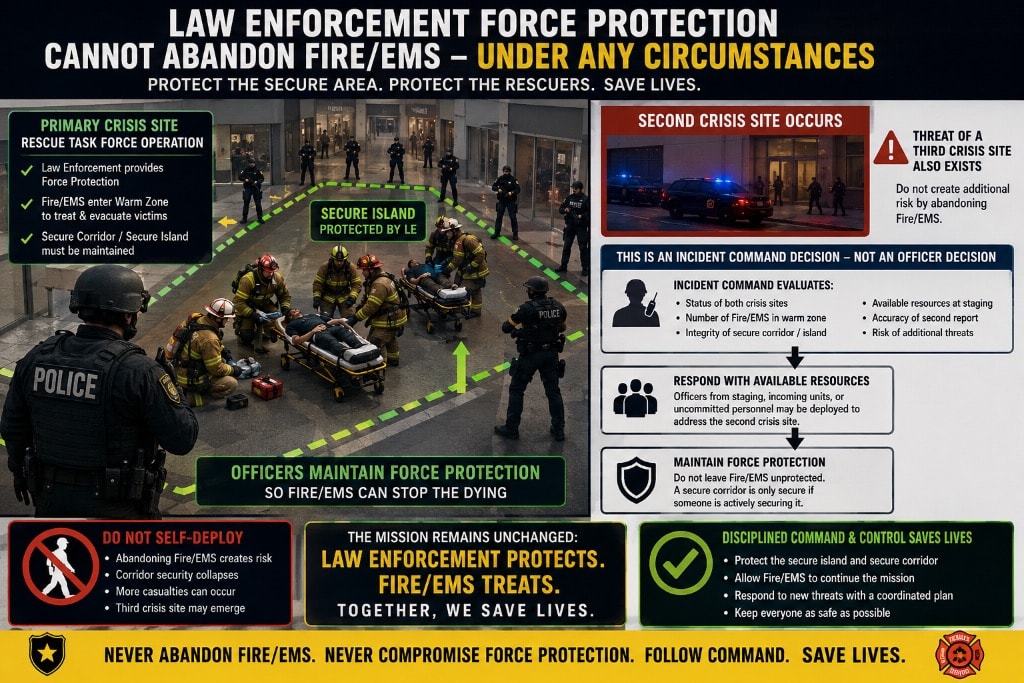
- RTFs bring Fire/EMS into cleared or protected areas.
- Secure corridors connect casualties with CCPs and ambulance transfer points.
- Unified Command coordinates security, medical operations, evacuation, and transportation.
- Hospitals and trauma systems prepare for the number, severity, and distribution of incoming patients.
The next evolution
The response cannot end at the ambulance transfer point. Hospitals are not passive destinations waiting for patients to arrive. They are part of the operational medical system.
Emergency departments, trauma centers, operating rooms, blood banks, regional medical coordination systems, ambulance providers, and specialty resources must receive timely information and coordinate patient distribution. Rapid removal from the crisis site accomplishes little if casualties encounter avoidable delays before reaching the right level of definitive care.
The modern response must therefore be understood as one continuous system:
Point of injury → immediate intervention → casualty movement → CCP → ambulance transfer → hospital → operating room
We have progressed from waiting for SWAT, to immediate patrol entry, to officer hemorrhage control, rescue teams, RTFs, Unified Command, and whole-community coordination. But policies and exercises do not always reflect the full evolution.
Every law-enforcement, Fire/EMS, and healthcare organization should ask:
Does our plan simply stop the attacker, or does it create a coordinated pathway that moves every potentially survivable casualty from the point of injury to definitive care without unnecessary delay?
Explore Topics
Written by
Paul Strauss MD
Content creator and writer sharing insights and stories.