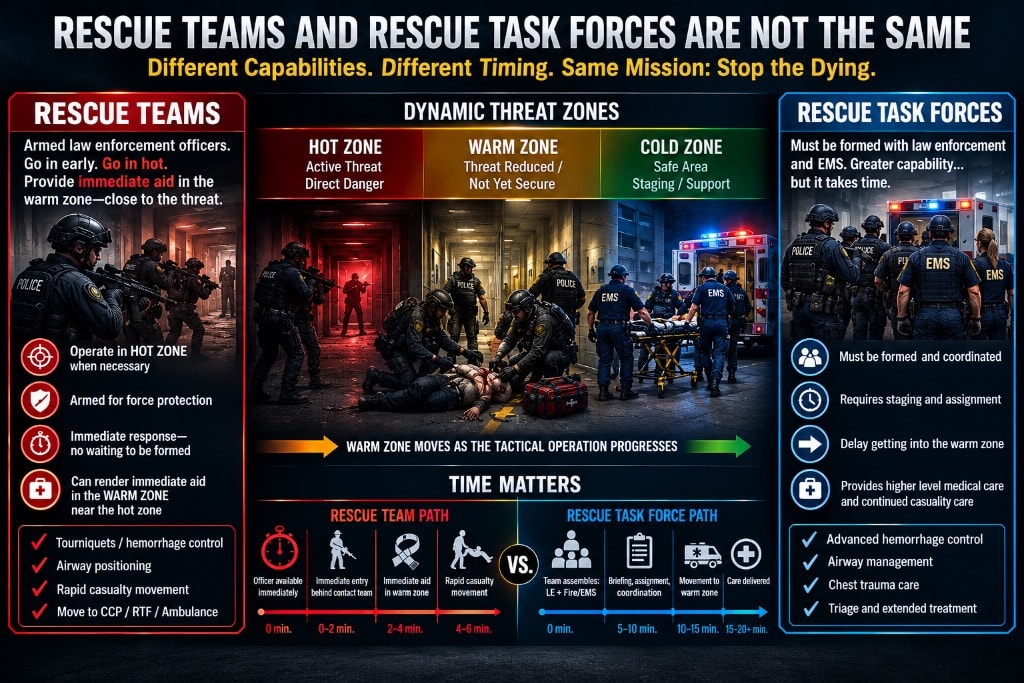
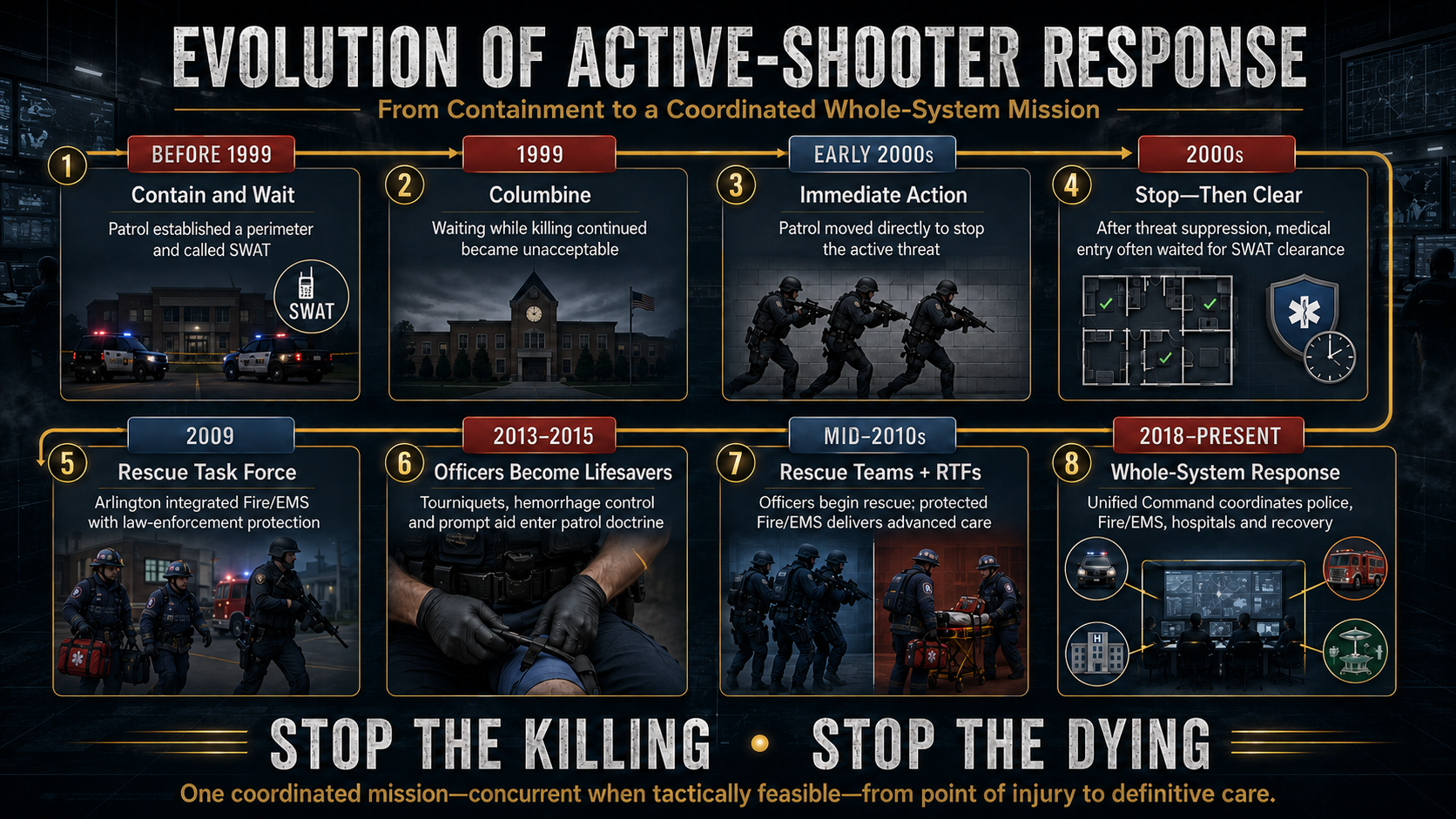
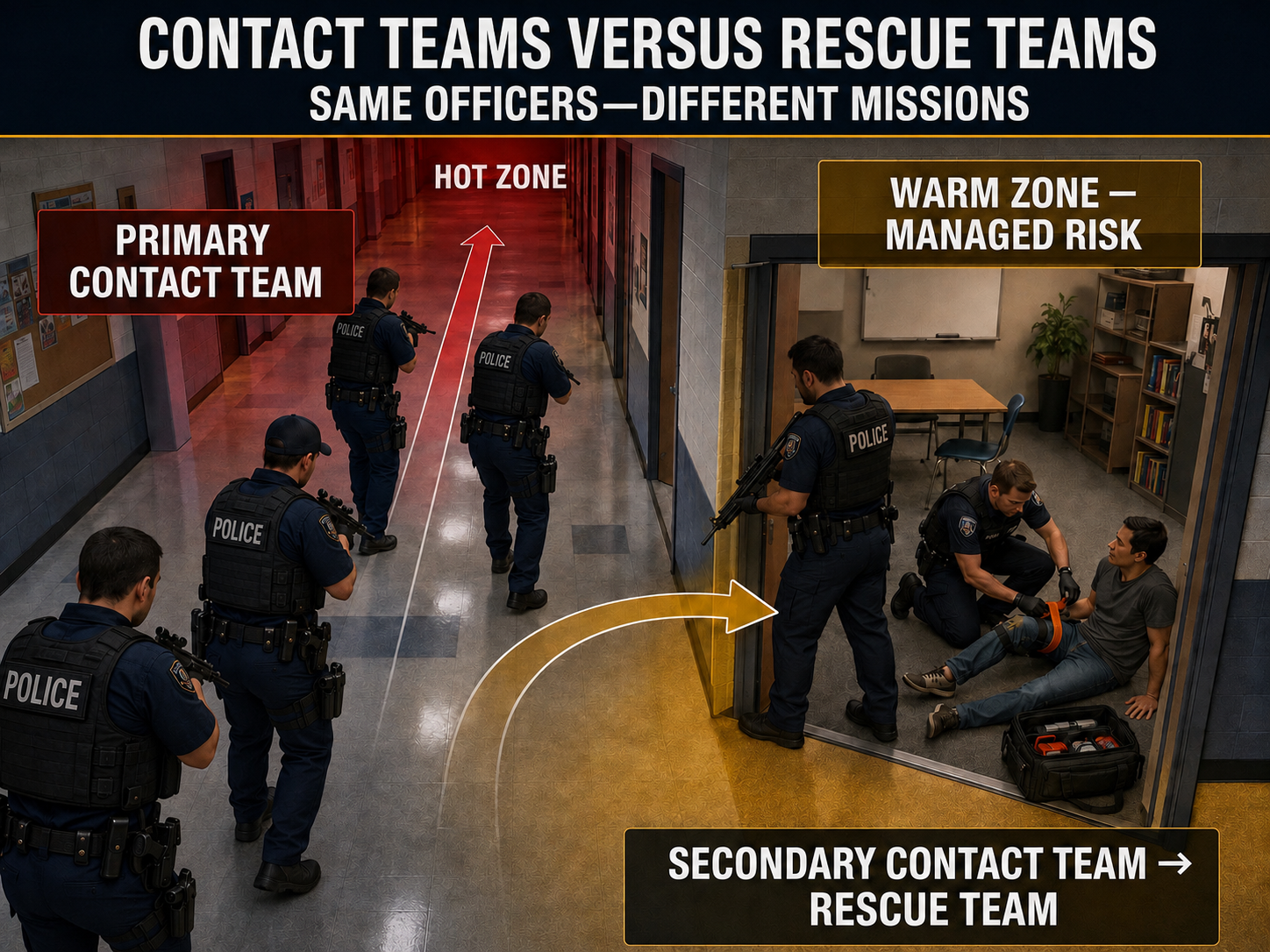
Rescue Task Force Force Protection: Never Abandon Fire/EMS
One of the most important principles of Rescue Task Force (RTF) operations is that law enforcement force protection personnel must never abandon Fire/EMS personnel operating within a secure corridor or secure island.
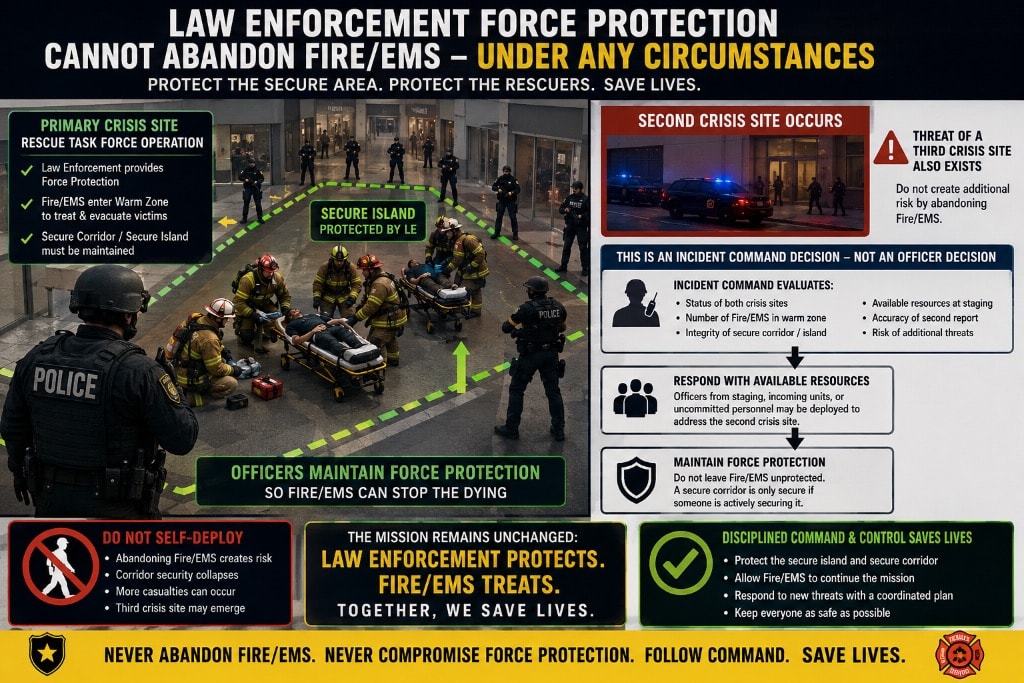
One of the most important principles of Rescue Task Force (RTF) operations is that law enforcement force protection personnel must never abandon Fire/EMS personnel operating within a secure corridor or secure island.
The entire concept of an RTF is built upon Fire/EMS entering areas that are not completely secure but have been made reasonably safe through law enforcement protection. Firefighters and paramedics accept risk to rapidly reach victims, but they do so with the understanding that armed law enforcement officers are providing continuous force protection.
A common concern during Active Shooter/Mass Casualty Incidents is the possibility of a second crisis site developing while RTF operations are already underway. The natural reaction of some officers may be to immediately self-deploy toward the new threat. However, doing so can create a far greater problem.
If officers assigned to RTF force protection leave their positions, they may leave unarmed Fire/EMS personnel exposed inside a warm zone or along a secure corridor. The moment force protection disappears, the protected environment ceases to exist. Firefighters and paramedics who were operating under the assumption of security suddenly become vulnerable to attack, and casualty care operations may collapse.
The proper response to a second crisis site is an Incident Command decision—not an individual officer decision.
- The current status of the existing crisis site.
- The number of Fire/EMS personnel operating in the warm zone.
- The integrity of secure corridors and secure islands.
- Available law enforcement resources at staging.
- The possibility that the second report may be inaccurate or incomplete.
- The potential for a third crisis site.
In many cases, officers assigned to staging, incoming resources, or uncommitted personnel should be deployed to investigate and address the second crisis site while maintaining force protection for ongoing rescue operations.
Equally important is recognizing that active attacks may involve deception, diversion, or multiple locations. Abandoning Fire/EMS to chase a second report may create an opportunity for additional casualties if a third crisis site emerges or if the original area is not as secure as believed.
The mission remains unchanged:
Law Enforcement protects. Fire/EMS treats.
Once Fire/EMS enters a warm zone under law enforcement protection, that protection must remain intact until Incident Command deliberately transitions, relieves, or withdraws those resources.
RTF force protection officers are not simply additional responders available for reassignment. At that moment, they are the security element protecting unarmed medical personnel and wounded victims.
A secure corridor is only secure if someone is actively securing it.
The decision to move officers from force protection duties belongs to Incident Command—not to individual officers acting independently.
During an Active Shooter/Mass Casualty Incident, disciplined command and control saves lives. Self-deployment creates risk. Maintaining force protection allows Fire/EMS to continue the mission of “Stop the Dying” while law enforcement manages emerging threats through coordinated command decisions.
#RescueTaskForce #RTF #ActiveShooterResponse #MassCasualtyIncident #StopTheKilling #StopTheDying #TacticalMedicine #TacMed #TECC #TEMS #LawEnforcement #FireEMS #UnifiedCommand #IncidentCommand #CommandAndControl #ForceProtection #RescueOperations #EmergencyManagement #PublicSafety #CrisisResponse #ActiveAttack #MCI #EMSLeadership #PoliceLeadership #EmergencyPreparedness #SecureCorridor #RescueCorridor #Interoperability #MultiAgencyResponse #TrainTogether #Leadership #DecisionMaking #RiskManagement #OperationalLeadership #LessonsLearned #TrainingAndExercises #ProfessionalDevelopment #LA28 #OlympicsPreparedness #EmergencyResponse #FirstResponders #SavingLives #MinutesMatter #IntegratedResponse #PublicSafetyLeadership
Explore Topics
Written by
Paul Strauss MD
Content creator and writer sharing insights and stories.