Slicing the Pie: Reducing the Suspect's Advantage
By moving incrementally around a doorway, an officer can gather information, limit exposure, and preserve rescue options before committing to entry—but the hard corner remains a problem slicing the pie cannot solve.
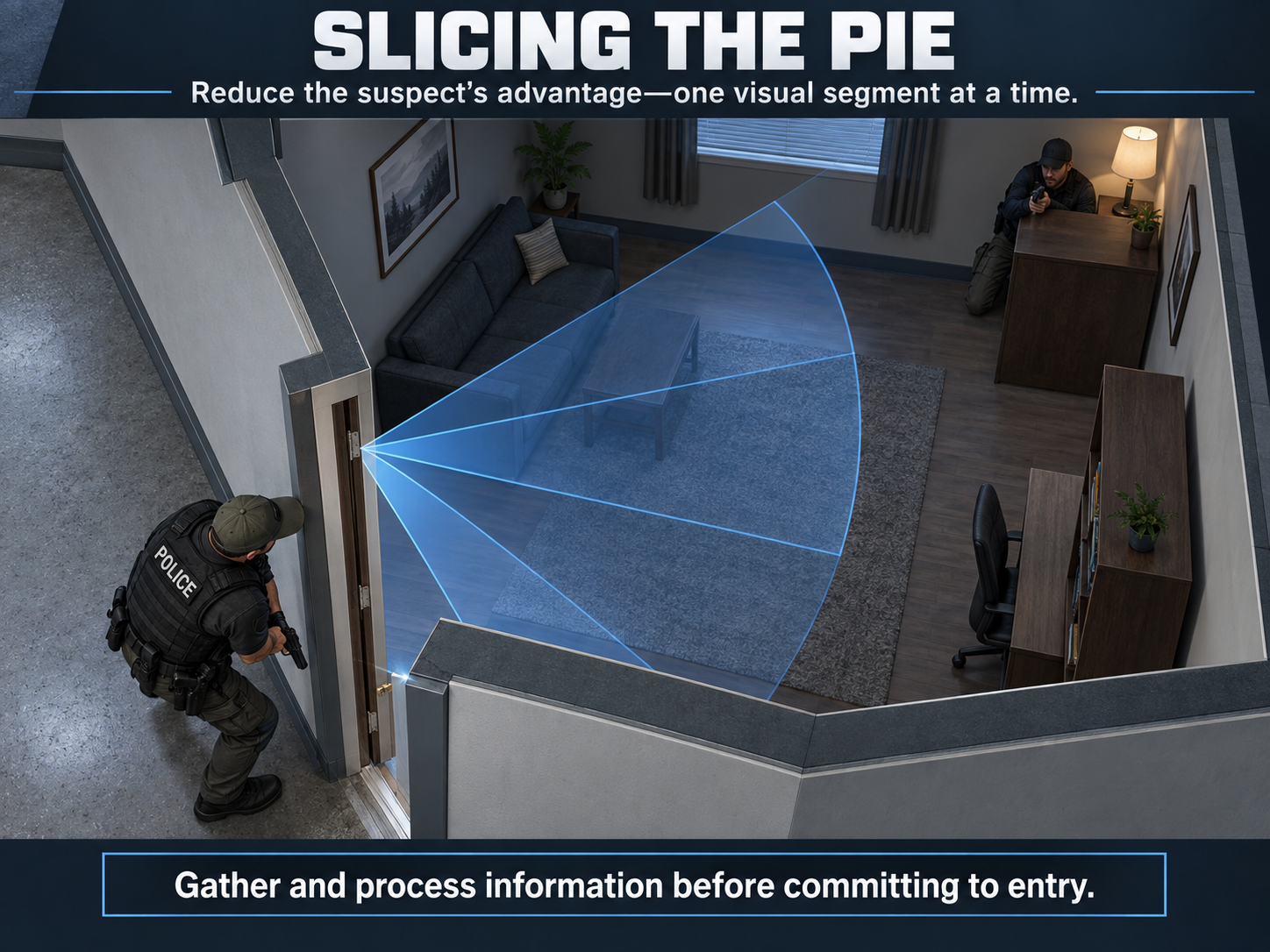
When an officer enters a room, a concealed suspect may have the advantage. The suspect may know the layout, have selected a position of cover or concealment, and be watching the doorway—the predictable point through which the officer must enter.
"Slicing the pie" from outside the room helps reduce that advantage. By moving incrementally around the doorway, the officer uses the edge of the doorframe as a visual boundary while viewing and processing one portion of the room at a time. This allows the officer to gather information without immediately committing their entire body to the doorway or entering the room.
From the officer's position, the doorway can minimize visual exposure. Only a limited portion of the officer may be visible as each angle is assessed. Meanwhile, a suspect standing in an exposed area of the room may become substantially—or even fully—visible from outside.
The doorframe, however, should not automatically be considered ballistic cover. It may help control how much of the officer is visually exposed, but its construction may provide little or no protection from gunfire.
Slicing the pie may help the officer:
- Limit visible exposure.
- Identify a potential threat before crossing the threshold.
- Process the room in manageable visual segments.
- Locate occupants, obstacles, cover and additional doorways.
- Reduce the amount of unknown space before entering.
- Preserve a more accessible position if injured.
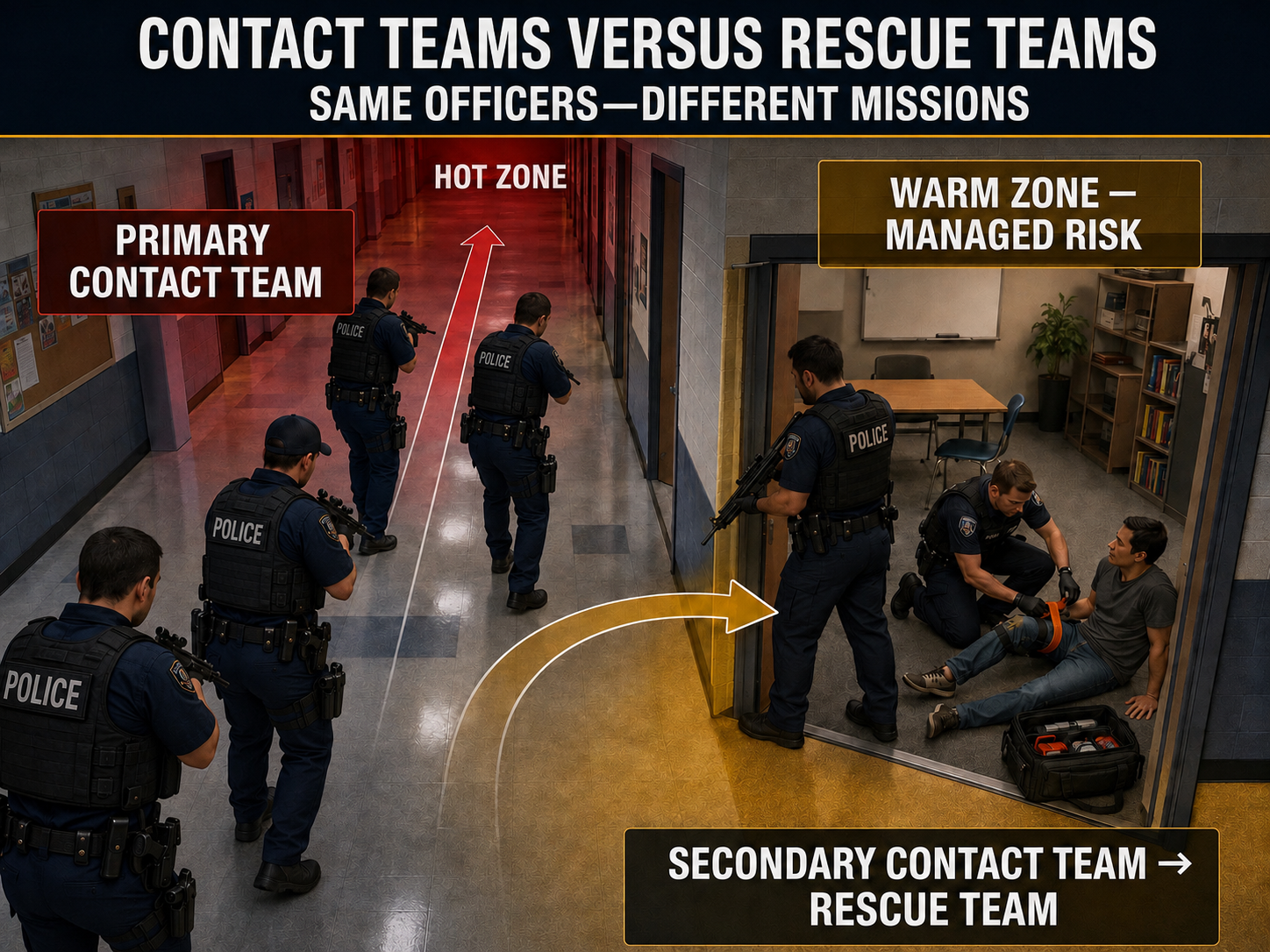
Remaining outside the room may also improve rescue options. If the officer is injured outside the suspect's room, another officer may have a better opportunity to provide protection, move the injured officer to a safer position and begin lifesaving care. If the officer is injured after crossing the threshold, the officer may remain inside the suspect's immediate area of control. Reaching and recovering that officer could expose additional officers to the same threat and delay medical care.
The Hard-Corner Problem
Slicing the pie cannot reveal every part of a room. A person positioned in a near "hard corner" may remain unseen until the officer crosses the threshold. At the final angle, the officer generally has two entry options: cross toward the opposite side or buttonhook into the near corner. Either movement requires the officer to enter an area that has not been visually cleared. If a suspect is waiting in that corner, the suspect may retain an action–reaction advantage. The suspect may already be positioned, watching the doorway and prepared to act. The officer must enter, locate the person, process what is happening and respond.
However, the officer cannot assume that every person hiding in the hard corner is the suspect. The person could be:
- The armed suspect.
- An innocent person hiding from the threat.
- An injured, frightened or disoriented victim.
- Someone holding an ordinary object that could initially be mistaken for a weapon.
- An off-duty or plainclothes officer.
The officer must rapidly determine whether the person presents an imminent threat. That requires evaluating the person's hands, behavior, movements, any objects being held, the surrounding circumstances and the person's response to commands—all while accounting for the possibility of additional people or threats. This creates a critical asymmetry: the concealed suspect may know that the entering officer is the intended target, but the officer must first determine whether the concealed person is a suspect or an innocent person before deciding whether force is justified.
Slicing the pie does not eliminate risk. Lighting, furniture, visual obstructions, deep corners, multiple occupants and the suspect's position can all limit what the officer can see from outside. Remaining near the doorway for too long may also allow a suspect to anticipate the officer's position. The objective is not to make the room safe from outside. It is to gather and process as much useful information as possible, minimize exposure and preserve rescue options before committing to entry.
Slicing the pie reduces the suspect's advantage—but that advantage may return when the officer must cross the threshold, identify the person in the hard corner and decide how to respond.
Explore Topics
Written by
Paul Strauss MD
Content creator and writer sharing insights and stories.