TACTICS
Warm Zones: Not All the Same
During the transition from "Stop the Killing" to "Stop the Dying," warm zones exist on a spectrum — and that spectrum can shift rapidly.
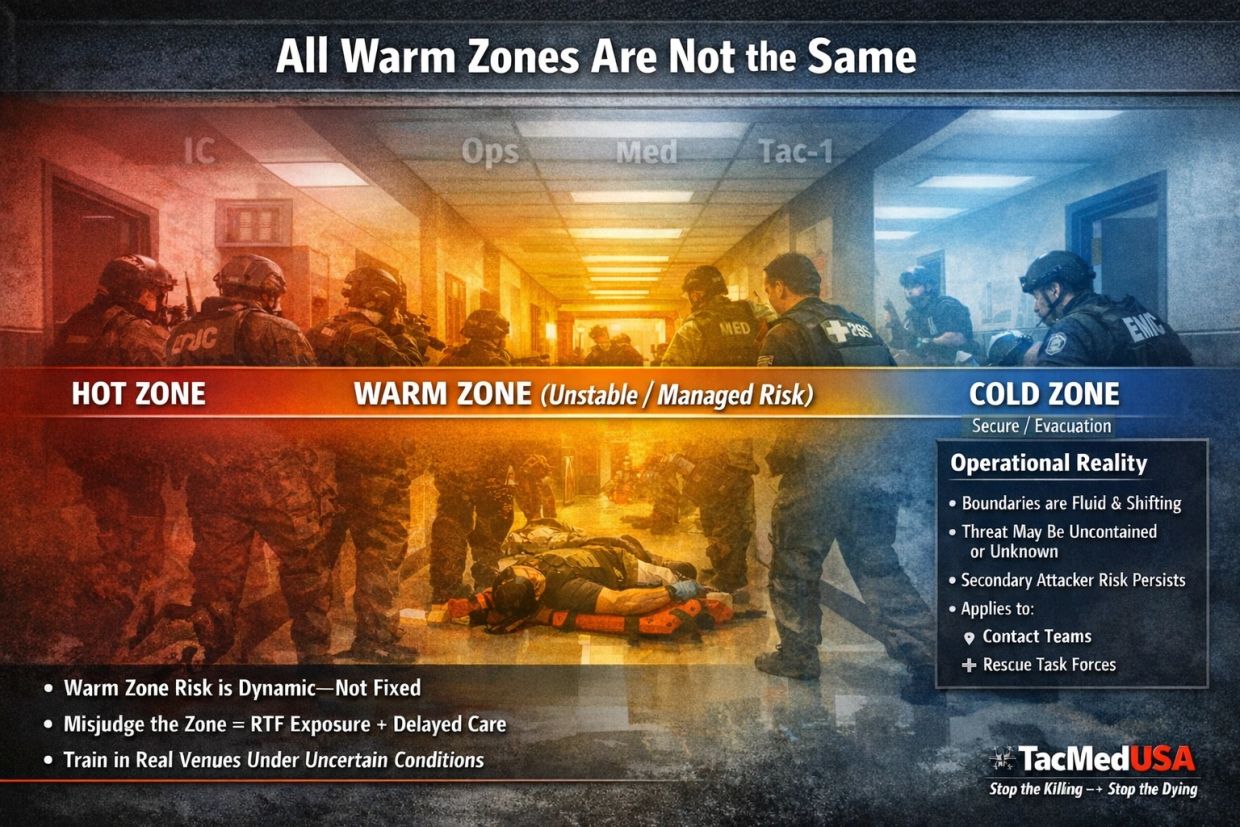
During the transition from "Stop the Killing" to "Stop the Dying," we rely on zones of care to guide operations. In the military model, these were clearly defined. In civilian Active Shooter / Mass Casualty Incidents, those boundaries are far less defined.
The so-called "warm zone" is not inherently safe — it exists on a spectrum. It can shift rapidly toward a hot zone if:
- →A suspect is not fully contained
- →A secondary attacker emerges
- →The threat picture is incomplete or evolving
This risk applies not only to initial law enforcement contact teams, but also to Rescue Task Forces operating under perceived protection. Compounding the problem, these incidents often occur in complex, unfamiliar environments, where limited situational awareness increases vulnerability and slows coordinated movement.
Operational Reality
A warm zone is not a location — it is a moment in time defined by risk.
If that risk is misunderstood, miscommunicated, or ignored:
- →RTFs are exposed
- →Force protection breaks down
- →The transition to life-saving care is delayed
Training Imperative
With upcoming large-scale events and the increasing threat of complex coordinated attacks, training must reflect reality:
- →Train in the actual venues
- →Operate in uncertain, shifting threat environments
- →Force decision-making under ambiguity
In a real incident, the "warm zone" will not be clearly marked — and it will not stay static.