TRAINING
Are We Training Officers to Succeed—
or Creating Training Scars?
Will our current training contribute to the deaths of the citizens we are sworn to protect? Will our training increase the risk of officer deaths or mistake-of-fact shootings? Most importantly, can we do better?
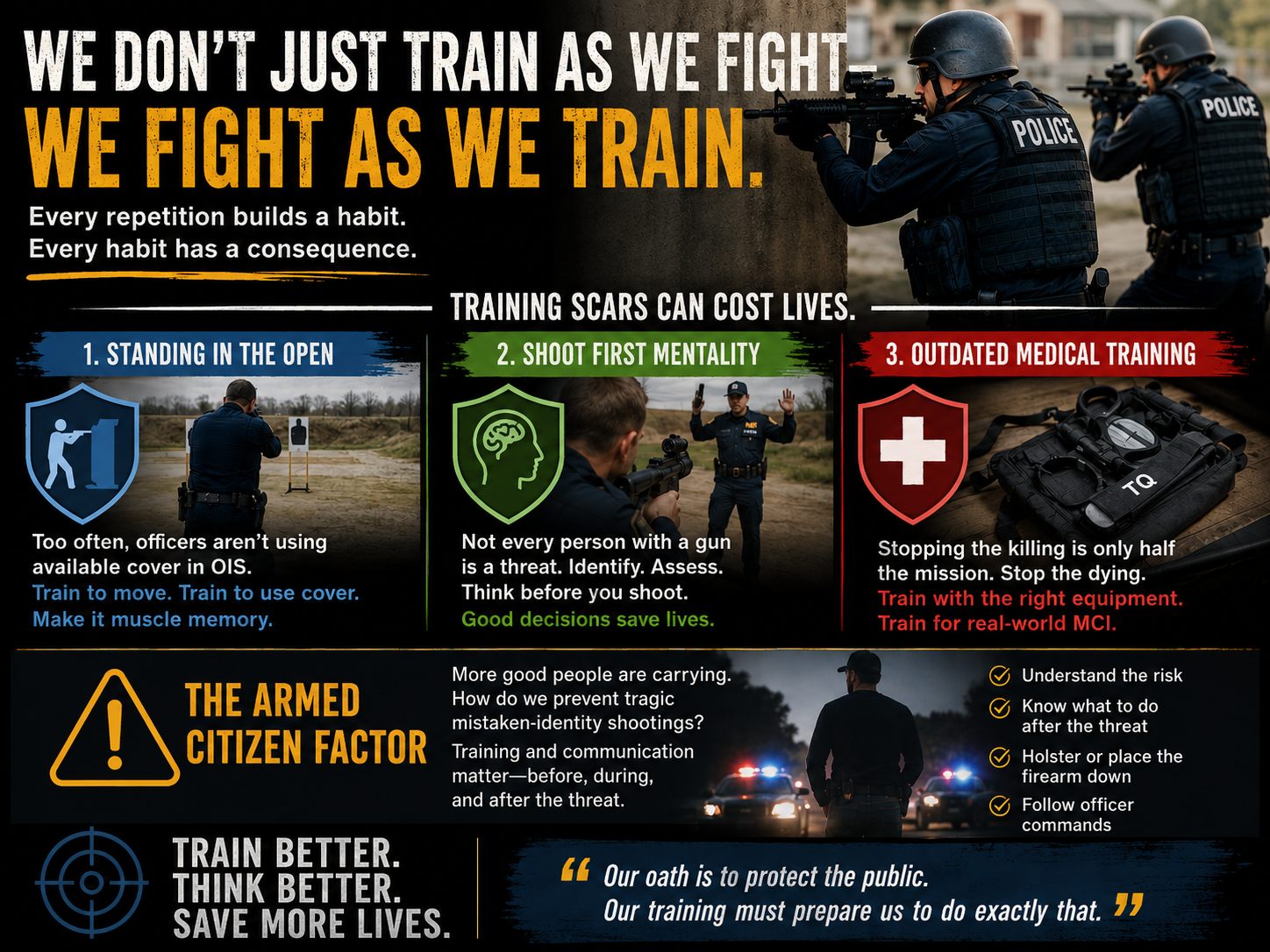
We often hear the phrase, "Train as you fight." But perhaps an equally important truth is:
We will fight as we train.
Every repetition in training develops habits, and habits become automatic under stress. While that is exactly what we want when we are building good skills, it also means we unintentionally create training scars—habits that work well on the training range but can have serious consequences in the real world. Old habits die hard.
Training Scar #1: Standing in the Open Instead of Using Cover
One of the most common observations from officer-involved shooting videos is that officers frequently fail to use available cover.
I have played the suspect during numerous force-on-force scenarios, and I can personally attest that you do not want to get into an open-air gunfight.
Could this behavior be traced back to how we train?
On a traditional flat range, officers stand in the open, directly facing a target, and spend the majority of their training refining marksmanship. While marksmanship is essential, the environment bears little resemblance to a real gunfight.
I know one highly respected firearms instructor who addresses this issue from the very first day of the academy. Every recruit begins each string of fire behind cover. A target backer is placed in front of the shooter, and before engaging the target, the recruit must move to and properly use cover.
Thousands of repetitions create muscle memory. When officers later encounter a real threat, seeking cover becomes an automatic response rather than an afterthought.
Perhaps we should be asking whether every firearms repetition should reinforce tactical survival—not just marksmanship.
Training Scar #2: Every Person Holding a Gun Becomes a Shoot Target
Another training scar I frequently observe occurs during paper-target and force-on-force training.
Too often, if a role player has a firearm, they become an automatic "shoot target."
Paper targets admittedly make decision-making difficult to simulate. It is challenging to teach officers to determine whether someone is truly the suspect and whether they present an immediate deadly threat.
Force-on-force training, however, offers the opportunity to teach those decisions.
Should every armed role player be shot?
Certainly not.
They may not be the suspect.
They may not pose an immediate threat.
They may even be another law enforcement officer.
I participated in one scenario where the role player was a uniformed police officer—with clearly visible police markings on the front, back, and both shoulders—detaining a suspect. Officers participating in the scenario had already been told that a School Resource Officer was on scene.
Despite those facts, approximately 70% of responding officers shot the uniformed officer.
The officers simply outran their ability to process information under stress.
Fortunately, it happened during training rather than in the real world.
But there is another side to this discussion.
If officers always pause to challenge every armed individual during an active shooter or armed burglary, they may place themselves at unnecessary risk because action often beats reaction.
The solution is not simplistic. It requires balancing rapid threat engagement with proper threat identification while maximizing the use of available cover to buy time for decision-making.
The Armed Citizen Challenge
The issue becomes even more complicated as more law-abiding citizens legally carry firearms.
Many of us encourage responsible armed citizens to stop an active killer if they are immediately present and capable of doing so before officers arrive.
But what happens after they stop the threat?
Do they know to holster or place the firearm on the ground before officers arrive?
Have they ever been taught how to reduce the chance of being mistaken for the suspect?
What if the suspect is wounded but still requires detention?
Does the citizen understand the significant risk of remaining armed while officers are arriving?
These are difficult questions, but they deserve discussion.
Tactical Medicine: Are We Still Teaching 2010?
The same concerns exist in tactical medical training.
Many active shooter medical programs focus on teaching patrol officers basic lifesaving interventions. That is important—but it is only part of the mission.
Too often, training fails to address the complexity of command and control during a mass casualty incident.
In 2010, active shooter doctrine focused almost exclusively on one objective:
Stop the Killing.
Once the threat was neutralized, the mission was largely considered complete.
Today, doctrine has evolved.
We now understand that Stopping the Killing is only the first half of the mission.
The second half—
Stop the Dying
—is what saves the greatest number of lives.
Victims must be found rapidly.
Life-threatening hemorrhage must be controlled.
Victims must be triaged.
Rescue Task Forces must be organized.
Casualties must be evacuated to Casualty Collection Points and Ambulance Transfer Points.
Most importantly, victims must reach definitive surgical care as quickly as possible.
That transition requires command and control, communications, coordination, and disciplined resource management—not simply medical skills.
Yet I continue to participate in active shooter courses around the country where officers receive little or no medical equipment during training—not even a dedicated training tourniquet.
How can officers develop confidence and competence with lifesaving interventions if they never practice them?
More importantly, are we unintentionally reinforcing a doctrine that was abandoned over fifteen years ago?
That, too, is a training scar.
Officers become proficient at stopping the killing but receive little realistic practice in treating, triaging, and transporting victims to higher levels of care.
Final Thoughts
Training is one of the few things we completely control.
If we consistently train officers to seek cover, think before they shoot, recognize friendly forces, manage encounters with legally armed citizens, and transition effectively from Stop the Killing to Stop the Dying, those behaviors become instinctive under stress.
If we fail to train those skills, we should not be surprised when they are absent during real incidents.
The goal of law enforcement training is not simply to produce officers who can win gunfights.
It is to produce officers who can make sound decisions under stress, survive the encounter, protect innocent lives, and lead the transition from neutralizing the threat to saving as many victims as possible.
Because in the end, we don't just train as we fight—
We fight as we train.
Author
Paul Strauss MD — TacMed USA