TACTICS
Officer Involved Shooting
Stopping the Killing is the easy part. Stopping the Dying is a command skill — and the hardest phase of the response.
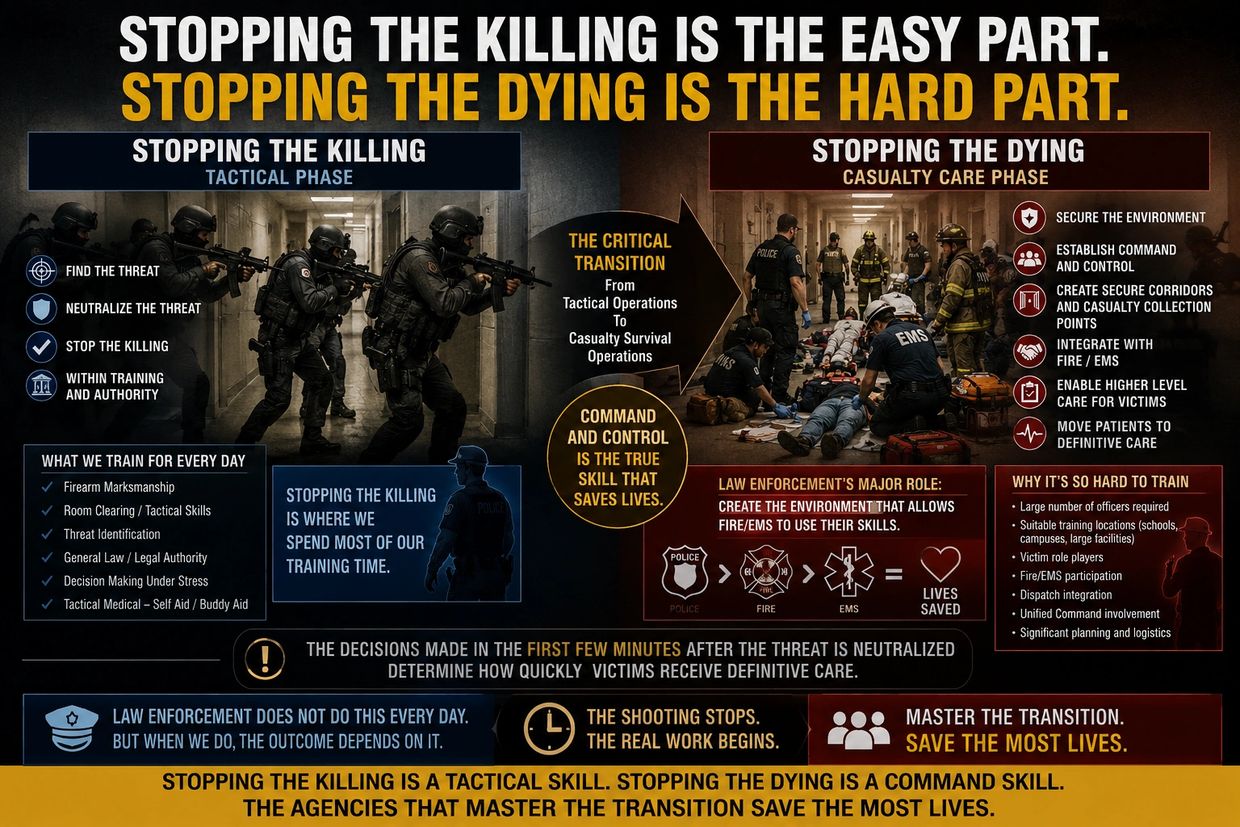
"Stopping the Killing is a tactical skill. Stopping the Dying is a command skill. The agencies that master the transition save the most lives."
In AS/MCI response, law enforcement training has historically focused on what officers know best: finding the threat and stopping the killing. Officers spend thousands of hours developing firearms proficiency, room clearing, tactical movement, threat identification, and decision-making under stress.
The reality is that "Stopping the Killing" is often the easier phase for law enforcement. The truly difficult phase is "Stopping the Dying."
The Most Important Lifesaving Skill
Once the threat is dead, contained, has fled, or is in custody, the mission must rapidly transition from tactical operations to casualty survival operations. This transition is not primarily a medical problem — it is a command and control problem.
The most important lifesaving skill law enforcement can provide during the Stop the Dying phase is not advanced medical care. It is creating an environment within the crisis site that allows Fire/EMS personnel to bring their expertise to the victims. Law enforcement must establish:
- →Security
- →Command and control
- →Secure corridors
- →Casualty collection points
- →Rescue Task Force integration
- →Resource accountability
- →Coordinated movement of patients to definitive care
Conducting realistic Stop the Dying training is difficult. It requires large numbers of officers, suitable venues, victim role players, Fire/EMS participation, dispatch integration, and significant planning. As a result, many agencies rarely conduct full-scale exercises that truly test the transition.
The future of AS/MCI response is not simply becoming better at stopping the threat. It is becoming better at recognizing when the threat phase is over and immediately transitioning to the lifesaving operations that follow. The greatest opportunity to save lives often begins the moment the shooting stops.