MEDICAL · HEMORRHAGE CONTROL
Wound Packing Technique
Beats Hemostatic Agent Choice
Paul Strauss MD · July 18, 2026
Effective wound packing is usually more important than the specific hemostatic agent. Both kaolin- and chitosan-based dressings can be highly effective when applied correctly. The key is getting the gauze to the bleeding source, packing the wound completely, and maintaining firm direct pressure.
Kaolin vs. Chitosan: The Debate
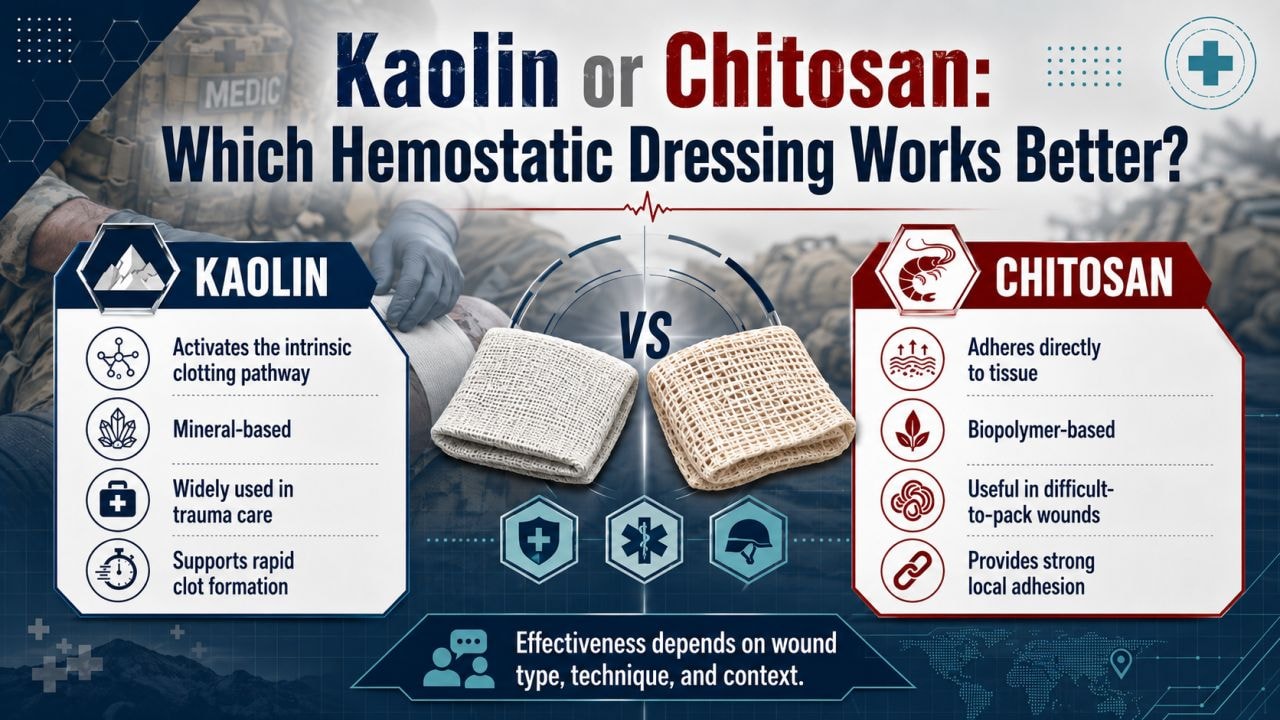
The question of which hemostatic dressing is superior — kaolin-based (e.g., Combat Gauze) or chitosan-based (e.g., Celox Gauze, ChitoGauze) — is a recurring one in TCCC and CLS training. Both are designed for the same purpose: controlling severe compressible bleeding when a tourniquet cannot be applied or when wound packing is required. But they work through different mechanisms.
Kaolin-based dressings support clot formation by activating the intrinsic coagulation pathway. Chitosan-based dressings create a mucoadhesive barrier by interacting with blood cells and tissues — working largely independently of the casualty's coagulation cascade. On paper, this difference might suggest one technology should be faster or more reliable. In practice, the evidence does not identify a universal winner.
2024 TCCC Guidelines
The 2024 TCCC Guidelines identify Combat Gauze as the hemostatic dressing of choice, with Celox Gauze and ChitoGauze listed as alternatives. They also recommend at least three minutes of direct pressure after applying any hemostatic dressing. Some chitosan products advertise shorter application times — but faster biochemical action does not compensate for poor wound packing.
Why Technique Wins Every Time
Regardless of the agent, three things must happen for a hemostatic dressing to work:
Reach the Bleeding Source
The gauze must be packed to the deepest point of the wound cavity — not just placed at the surface. Superficial packing leaves the bleeding vessel untouched.
Pack the Wound Completely
The entire wound cavity must be filled firmly. Gaps allow blood to pool around the dressing rather than being absorbed and activating the hemostatic mechanism.
Maintain Firm Direct Pressure
Uninterrupted pressure must be held for the full recommended time. Releasing pressure early — even briefly — can disrupt clot formation and restart hemorrhage.
Training Implications
When evaluating hemostatic dressings for training programs, Strauss argues the comparison should go beyond active ingredients. Instructors and program directors should also examine:
How easily can the gauze be packed while wearing gloves?
How does it behave when fully saturated with blood?
Does it remain where it was placed under pressure?
How easy is it to maintain effective pressure?
How reliably can the technique be reproduced under stress?
What is the familiarity level of your personnel with this product?
The Bottom Line
"Under stress, the best dressing is the one your personnel have trained with repeatedly and can apply quickly and consistently."
— Paul Strauss MD, TacMed USA