MEDICAL · PENETRATING TRAUMA
Gunshot Wounds
to the Chest
Three Life-Threatening Problems. One Priority: Get to Surgery.
Paul Strauss MD · July 19, 2026
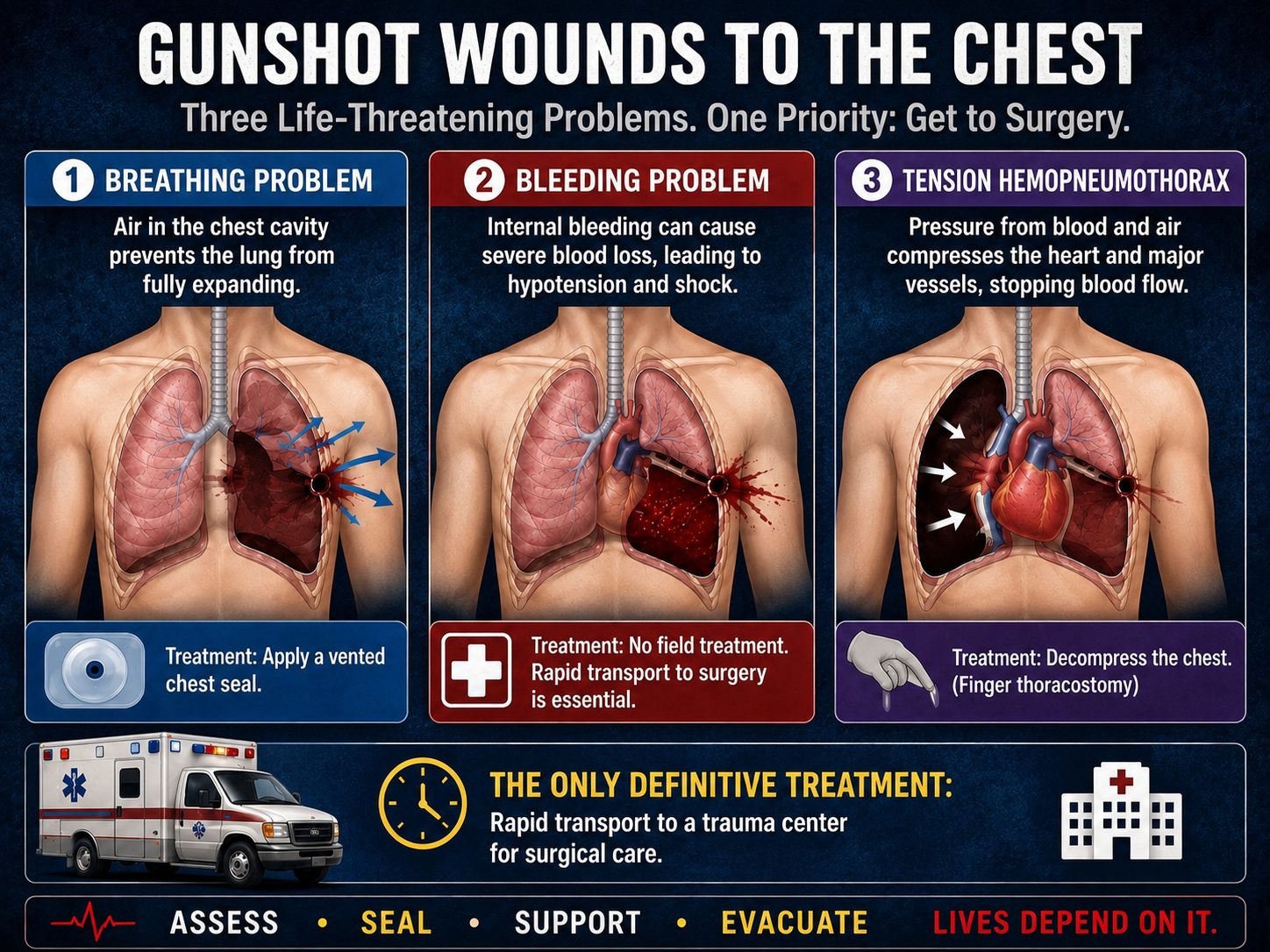
A gunshot wound to the chest creates two immediate life-threatening problems: a breathing problem and a bleeding problem. If either progresses untreated, the victim may develop a tension hemopneumothorax, one of the most rapidly fatal complications of penetrating chest trauma. Understanding the underlying physiology helps explain why rapid transport to definitive surgical care is the most important priority.
The Breathing Problem
Under normal conditions, the lungs expand because the chest cavity develops negative intrathoracic pressure during inspiration. A penetrating injury to the chest allows air to enter the pleural space, disrupting this negative pressure. As a result, the affected lung partially or completely collapses (pneumothorax), reducing the victim's ability to oxygenate.
Traditionally, treatment has emphasized applying a vented chest seal over the wound. The purpose is to limit additional air entering through the chest wall while still allowing trapped air to escape.
However, chest seals are not without potential complications. If air or blood continues to accumulate within the pleural cavity faster than it can escape, pressure can progressively build inside the chest. This can ultimately result in a tension hemopneumothorax, a condition requiring immediate decompression.
It is important to recognize that patients can survive with significantly reduced lung capacity. Many individuals live normal lives after removal of a lung or portions of a lung for conditions such as lung cancer or severe COPD. While restoring ventilation is important, it is often not the only—or even the most urgent—physiologic problem.
Field treatment: Apply a vented chest seal.
The Bleeding Problem
A penetrating injury to the chest may also produce massive internal hemorrhage.
Unlike extremity wounds, where a tourniquet can immediately stop bleeding, there is no field intervention capable of controlling significant intrathoracic hemorrhage. The chest cavity can hold a tremendous volume of blood—potentially more than a liter on one side, and in severe injuries substantially more—leading to hemorrhagic shock and death.
When bleeding occurs from the lung or major vessels within the chest, definitive hemorrhage control requires surgery. The surgeon may need to perform a thoracotomy and repair or resect the injured lung, control bleeding vessels, or address cardiac or vascular injuries. This has important implications for triage.
If an extremity hemorrhage is successfully controlled with a tourniquet, that patient's immediate risk of exsanguination is dramatically reduced. Their priority may decrease because definitive bleeding control has already been achieved.
In contrast, a victim with uncontrolled intrathoracic bleeding remains actively hemorrhaging until reaching the operating room. Every minute of delay increases the likelihood of shock, cardiac arrest, and death. For this reason, patients with suspected major chest hemorrhage should be rapidly transported to a trauma center capable of emergency thoracic surgery.
Field treatment: No field treatment. Rapid transport to surgery is essential.
Tension Hemopneumothorax
The most dangerous progression of penetrating chest trauma occurs when both air and blood accumulate within the pleural cavity under pressure.
As pressure rises, it shifts the mediastinum and compresses the heart and great vessels. The vena cava becomes compressed, reducing venous return to the heart, while cardiac filling becomes severely impaired. The result is obstructive shock with rapidly falling cardiac output. Without immediate treatment, circulatory collapse and death can occur within minutes. The treatment is rapid decompression of the pleural space.
Historically, needle decompression was widely taught as the initial intervention. However, increasing evidence has demonstrated limitations, including failure to penetrate the pleural space, catheter kinking, obstruction by blood or tissue, and inadequate decompression in many adult patients. Because of these limitations, many trauma systems are increasingly adopting finger thoracostomy for appropriately trained advanced providers. By creating a surgical opening into the pleural cavity, finger thoracostomy provides a larger, more reliable pathway for both air and blood to escape than a needle catheter.
The issue with simply applying a chest seal to all chest injuries as a result of gunshots, is that you are creating the conditions for a tension hemopneumothorax. Once a chest seal is placed, the victim needs to be monitored for the signs and symptoms of increased intrathoracic pressure such as anxiety, increase rate of breathing and/or heart rate. Law enforcement is typically task overloaded in these active shooter/mass casualty incidents. Additionally law enforcement lacks the clinical experience to recognize these signs and symptoms. Missing the early signs with time to intervene will result in mortality that should be preventable. Simply not putting a chest seal in the first place, fixes this problem.
Similarly, simply lifting ("burping") a chest seal may not adequately relieve pressure if the wound itself is too small or becomes obstructed by clot or tissue. Decompression requires an opening large enough to effectively vent the accumulating air and blood. Ultimately the solution is to transport the victim to a hospital and onto a surgical table to have the lung repaired.
Field treatment: Decompress the chest. (Finger thoracostomy)
The Bottom Line
Penetrating chest trauma presents three potentially fatal physiologic problems:
Loss of lung expansion due to disruption of normal negative intrathoracic pressure.
Massive internal hemorrhage that cannot be controlled in the field.
Tension hemopneumothorax, causing obstructive shock by compressing the heart and great vessels.
Field interventions—including chest seals, decompression, oxygenation, and supportive care—are important temporizing measures. However, they do not provide definitive treatment for major penetrating chest injuries.
The only definitive treatment for significant gunshot wounds to the chest is rapid transport to a trauma center where surgical intervention can control hemorrhage, decompress the chest when necessary, and repair the underlying injuries. In penetrating chest trauma, minutes matter, and getting the patient to an operating room as quickly as possible remains the intervention most likely to save a life.