MEDICAL
CPR in the Face of Hemorrhagic Shock
Control the bleeding first. CPR cannot pump blood that isn't there.
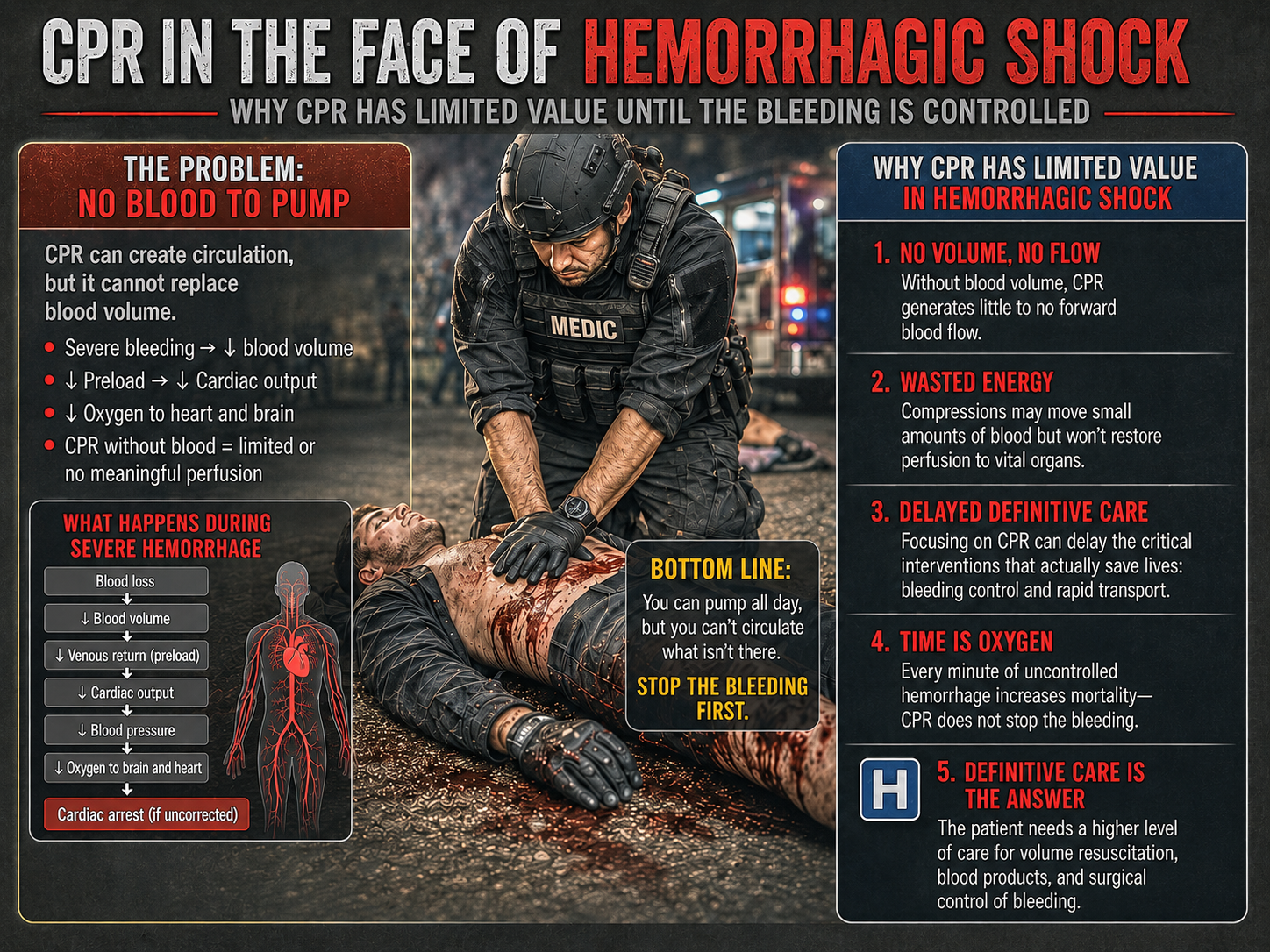
The Problem: No Blood to Pump
Cardiac arrest caused by hemorrhagic shock is fundamentally different from cardiac arrest caused by a primary cardiac event. In hemorrhagic shock, the heart often stops because there is not enough circulating blood volume to sustain life — not because the heart itself has failed. Under these circumstances, CPR alone has little to no chance of restoring meaningful circulation until the source of bleeding is controlled.
Chest compressions can generate limited blood flow, but they cannot create blood volume that no longer exists. As severe blood loss continues, venous return to the heart falls, preload decreases, cardiac output collapses, and oxygen delivery to the brain and heart rapidly deteriorates. Eventually, cardiac arrest occurs because the circulatory system is essentially empty.
Why CPR Has Limited Value in Hemorrhagic Shock
01
No Volume, No Flow
Without blood volume, CPR generates little to no forward blood flow. Compressions move what remains — but when the tank is empty, there is nothing to circulate.
02
Wasted Energy
Compressions may move small amounts of blood but will not restore perfusion to vital organs. The effort is real; the physiological return is minimal.
03
Delayed Definitive Care
Focusing on CPR can delay the critical interventions that actually save lives: hemorrhage control and rapid transport to a trauma center capable of surgical bleeding control.
04
Time Is Oxygen
Every minute of uncontrolled hemorrhage increases mortality. CPR does not stop the bleeding — and the bleeding is what is killing the patient.
05
Definitive Care Is the Answer
The patient needs a higher level of care for volume resuscitation, blood products, and surgical control of bleeding. CPR buys time only if those interventions are simultaneously underway.
The Correct Sequence
The interventions most likely to save the patient's life in hemorrhagic shock are not the same as those for a primary medical cardiac arrest. The sequence is:
- →Immediately control life-threatening hemorrhage using direct pressure, wound packing, or a tourniquet when indicated.
- →Rapidly transport the patient to a trauma center capable of surgical hemorrhage control.
- →Restore circulating blood volume with whole blood or blood products as soon as possible.
- →Definitive surgical control of bleeding is the intervention that ultimately reverses hemorrhagic shock.
Control the bleeding → Restore blood volume → Transport to definitive care → Then circulation has a chance to return.
Why Officers Still Perform CPR in These Situations
Understanding why CPR is initiated — even when hemorrhagic shock is the likely cause — is important for training and protocol development.
CPR Is Deeply Ingrained
Every first responder is taught that a pulseless patient requires immediate high-quality CPR. This reflex is appropriate for most medical cardiac arrests and has become the default response regardless of mechanism.
Cause of Arrest Is Often Unknown
An officer arriving on scene may not know whether the patient arrested from a heart attack, severe blood loss, or a tension pneumothorax. CPR is initiated while the assessment continues.
Early Hemorrhagic Shock May Still Respond
Early in hemorrhagic shock, enough remaining blood volume may exist that CPR can provide some perfusion while hemorrhage control and rapid evacuation are occurring. As blood loss becomes profound, the benefit rapidly diminishes.
Protocols and Legal Expectations
Many EMS and law enforcement protocols require CPR unless injuries are clearly incompatible with life or local termination-of-resuscitation criteria are met. Officers should follow their agency's protocols and medical direction.
CPR as a Parallel Intervention — Not the Primary Focus
If cardiac arrest has already occurred, CPR may be appropriate while life-saving interventions are being performed simultaneously. The critical point is that CPR must not become the primary focus if it delays those interventions.
Ideally, one team member performs compressions while others:
- →Control life-threatening bleeding.
- →Apply tourniquets or pack wounds.
- →Prepare rapid evacuation.
- →Coordinate transport to a trauma center.
The goal is not merely to perform CPR — it is to restore effective perfusion by correcting the underlying cause of the arrest. In traumatic hemorrhagic shock, stopping the bleeding saves lives. CPR alone does not.