TACTICS
AS/MCI Command & Control
The in-to-out flow of law enforcement command and control during an Active Shooter / Mass Casualty Incident.
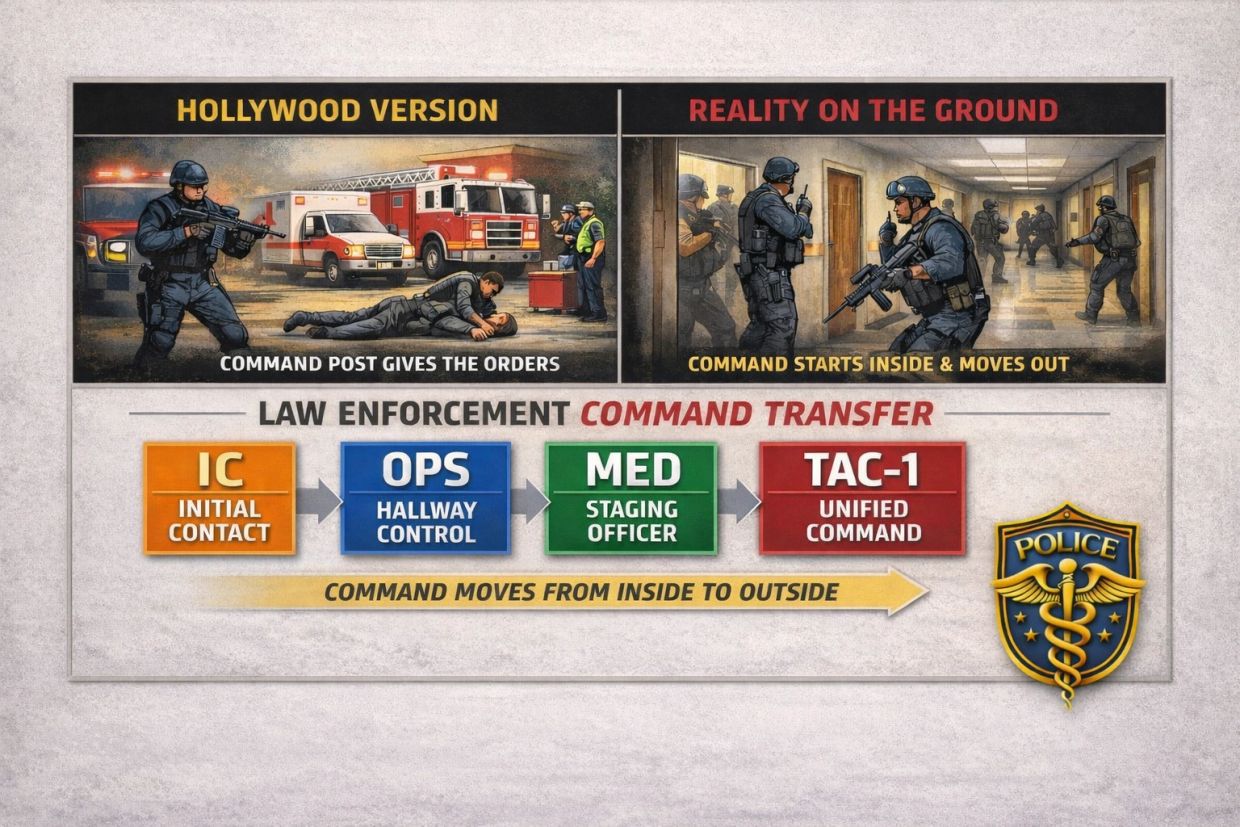
The Hollywood Model vs. Reality
We tend to envision active shooter and mass casualty incidents like the movies — law enforcement neutralizes the threat, Fire/EMS arrives with engines and ambulances, a command post is established, and senior leaders direct operations from the outside.
That is not how it actually unfolds.
Where Command Really Begins
In reality, command and control for law enforcement starts inside the crisis site — with the first officers through the door.
- →The initial contact officers are not just stopping the threat
- →They are establishing real-time command based on direct situational awareness
- →Decisions are made in the moment, under pressure, with incomplete information
This interior command evolves through phases:
- 1.Initial contact / threat engagement
- 2.Expansion of control (room, hall, floor)
- 3.Establishment of movement pathways and secure corridors
- 4.Transition of command toward the exterior
Interior → Exterior Command Transition
Unlike Fire/EMS — who typically establish command from the exterior upon arrival — law enforcement must push command outward from the inside.
This requires deliberate, structured transfer:
- →From initial contact officers
- →To hallway or area control officers
- →To a Staging Manager positioned just outside the crisis site
- →Ultimately integrating into Unified Command
This transition must be:
- →Intentional
- →Communicated clearly
- →Executed without delay
Rank vs. Situational Awareness
This model challenges traditional hierarchy.
- →The most senior officer is not always the initial decision-maker
- →The officer with the best real-time situational awareness — often a patrol officer — may function as the initial incident commander
This demands:
- →Individual initiative
- →Understanding of command flow
- →Confidence to assume and transfer command appropriately
Operational Bottom Line
Effective response depends on:
- →Rapid establishment of interior command
- →Structured expansion of control within the crisis site
- →Efficient creation of secure corridors for rescue and evacuation
- →Seamless transfer to exterior command and Unified Command integration
Command doesn't start at the command post.
It starts with the first officer inside — and must deliberately move outward.