COMMAND & STATISTICS
94% In 10 Minutes
What the data says about active shooter timelines — and what it demands of the officers who arrive first.
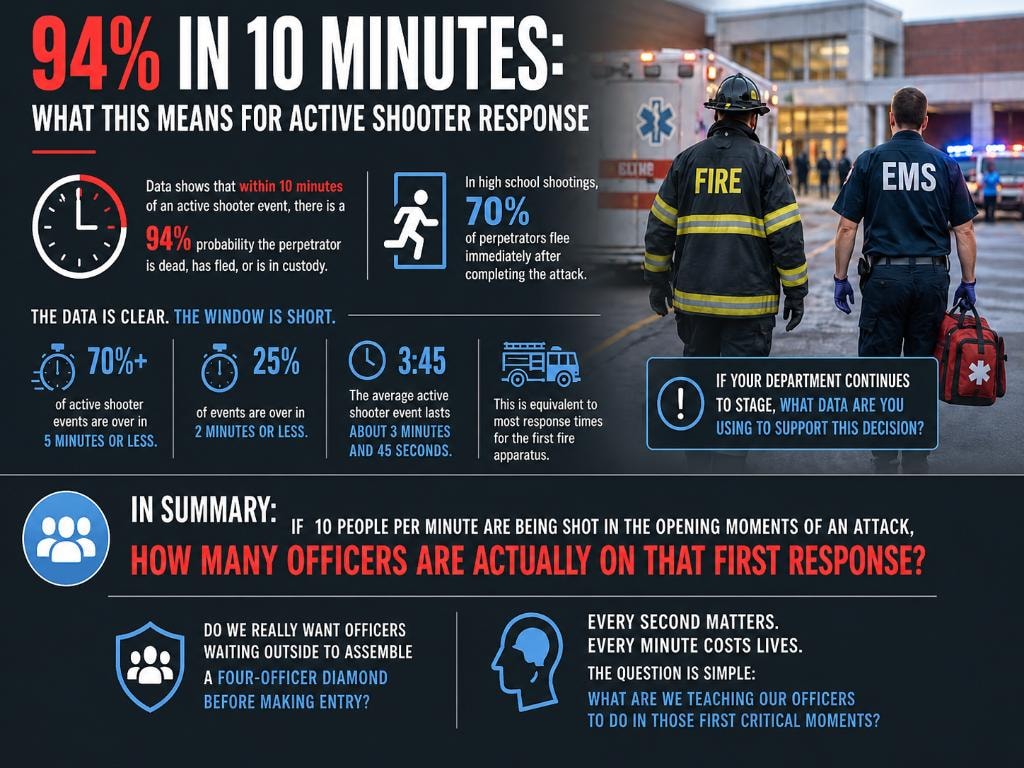
94% IN 10 MINUTES
Data consistently shows that within the first 10 minutes of an active shooter event, there is roughly a 94% probability the suspect is dead, has fled, or is already in custody.
The Data Is Clear. The Window Is Short.
Active shooter events are not prolonged sieges. The data is unambiguous:
70%+
of active shooter events are over in 5 minutes or less
25%
of events are over in 2 minutes or less
3:45
average active shooter event duration
70%
of perpetrators flee immediately after completing the attack (high school shootings)
Compare That to Response Times
Even in well-resourced urban systems, the time from a 911 call through dispatch, officer recognition, travel, arrival, and deployment into the structure often consumes most — or all — of that critical timeline. Fire/EMS response and staging frequently occur even later.
The average active shooter event lasts approximately 3 minutes and 45 seconds. That is roughly equivalent to the response time for the first fire apparatus in many jurisdictions. The incident is usually evolving — or ending — before large-scale coordinated resources arrive.
IF YOUR DEPARTMENT CONTINUES TO STAGE — WHAT DATA ARE YOU USING TO SUPPORT THAT DECISION?
Staging protocols designed for barricaded suspects or hostage situations do not apply to active shooter events. The threat profile is fundamentally different.
The First Officers Are the Response
The first arriving officers are not simply holding until more help gets there. They are the response. They are the incident command. They are the rescue force.
If 10 people per minute are being shot in the opening moments of an attack, how many officers are actually on that first response? Do we really want officers waiting outside to assemble a perfect four-officer formation while victims continue to die inside?
What Modern Doctrine Must Emphasize
- Immediate action — not staged assembly
- Patrol-driven incident command from the moment of first contact
- Rapid transition from Stop the Killing → Stop the Dying
- Early corridor control to enable Fire/EMS integration
- Coordinated rescue and evacuation — not just neutralization
EVERY SECOND MATTERS. EVERY MINUTE COSTS LIVES.
The first officers on scene are not just tactical responders — they are the bridge between chaos and organized rescue. The question is simple: what are we teaching our officers to do in those first critical moments?